
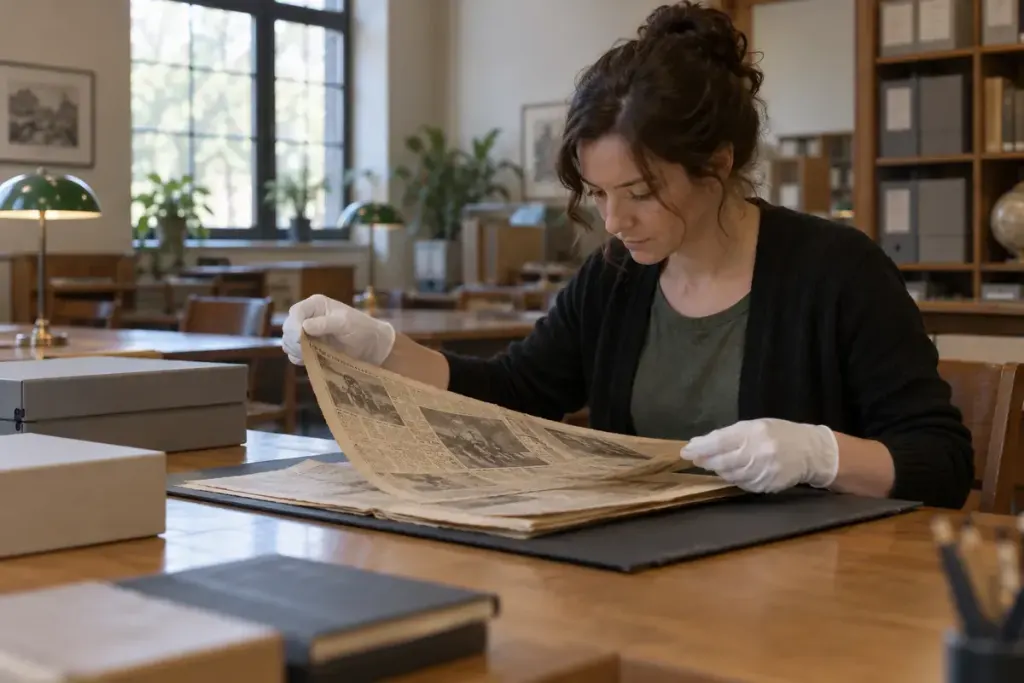
A neighbourhood newsletter disappears from its publisher’s website. A town history booklet is no longer sold. Before concluding that the publication has vanished, check whether a national or other designated library may hold it through legal deposit.
Legal-deposit arrangements differ by country. As one example, the British Library explains its system for publications distributed in the UK and Ireland, including print and electronic material. That example does not establish the rules or completeness of a collection elsewhere.
Search for the publication you actually need
Gather the title, publisher, approximate date, issue number and any alternative title. A local newsletter may have changed its name or issuing organisation. Search the library catalogue with more than the place name, which can return many unrelated records.
Keep a simple research note: where you searched, which spelling you used, what date range you checked and which record appeared relevant. This prevents the next search from repeating the same unsuccessful steps.
A catalogue record is not a promise of immediate access
Confirm whether the item is available, whether it must be ordered in advance and whether access is restricted to a reading room. Electronic deposit does not automatically mean a freely downloadable copy. Service disruptions or uncatalogued holdings can also make an online search incomplete.
When contacting a librarian, ask a bounded question: “Do you hold issue 12 from approximately 1998, under either of these titles?” Include what you already found. Avoid sending only a photograph with no publication details.
If the deposit collection cannot help, try local archives, historical societies and the issuing organisation. An absence in one catalogue is not proof that nobody preserved the item. Legal deposit is a valuable additional route because it looks beyond the current publisher’s shelves, while still requiring careful verification of the exact issue and access arrangements.