Kalau bicara soal liburan ke Eropa, nama yang muncul biasanya itu-itu lagi.
Paris.
London.
Rome.
Amsterdam.
Barcelona.
Prague.
Semua kota tersebut memang menarik.
Masalahnya?
Kita bukan satu-satunya orang yang berpikir begitu.
Datang saat peak season dan pengalaman yang dibayangkan romantis bisa berubah menjadi:
antre.
macet.
penuh wisatawan.
restoran penuh.
harga hotel naik.
dan spot foto yang bahkan sulit dinikmati karena terlalu ramai.
Menariknya, kadang perjalanan yang paling kita ingat justru bukan terjadi di kota besar.
Melainkan di sebuah kota kecil yang awalnya hanya direncanakan sebagai:
tempat singgah.
Tidak ada itinerary panjang.
Tidak ada daftar 20 tempat yang harus dikunjungi.
Kita cuma berjalan.
Makan.
Duduk di cafe.
Melihat bangunan lama.
Ngobrol dengan orang lokal.
Lalu tiba-tiba sadar:
“Kok gue malah lebih suka di sini?”
Itulah daya tarik kota kecil.
Kota Besar Memberi Banyak Pilihan
Ini keunggulannya.
Museum.
Shopping.
Nightlife.
Restaurant.
Landmark.
Event.
Public transport.
Semua tersedia.
Kalau pertama kali datang ke suatu negara:
kota besar memang menjadi pilihan paling gampang.
Tapi Banyak Pilihan Juga Bisa Melelahkan
Bangun pagi.
Museum jam 9.
Landmark jam 11.
Lunch jam 12.
Train jam 1.
Shopping jam 3.
Sunset jam 6.
Dinner reservation jam 8.
Pulang liburan:
butuh liburan lagi.
Kita terlalu sibuk menyelesaikan itinerary sampai lupa menikmati tempatnya.
Kota Kecil Memaksa Ritme Berubah
Tidak ada 40 attraction.
Mungkin hanya ada:
old town.
church.
market.
river.
local restaurant.
small museum.
Dan justru karena pilihannya sedikit:
kita mulai memperhatikan detail.
Kita Berjalan Lebih Pelan
Tidak mengejar metro.
Tidak terus melihat Google Maps.
Tidak merasa harus “maximize” hari.
Travel kembali terasa seperti:
travel.
Bukan project management.
destinasi kota kecil di Eropa
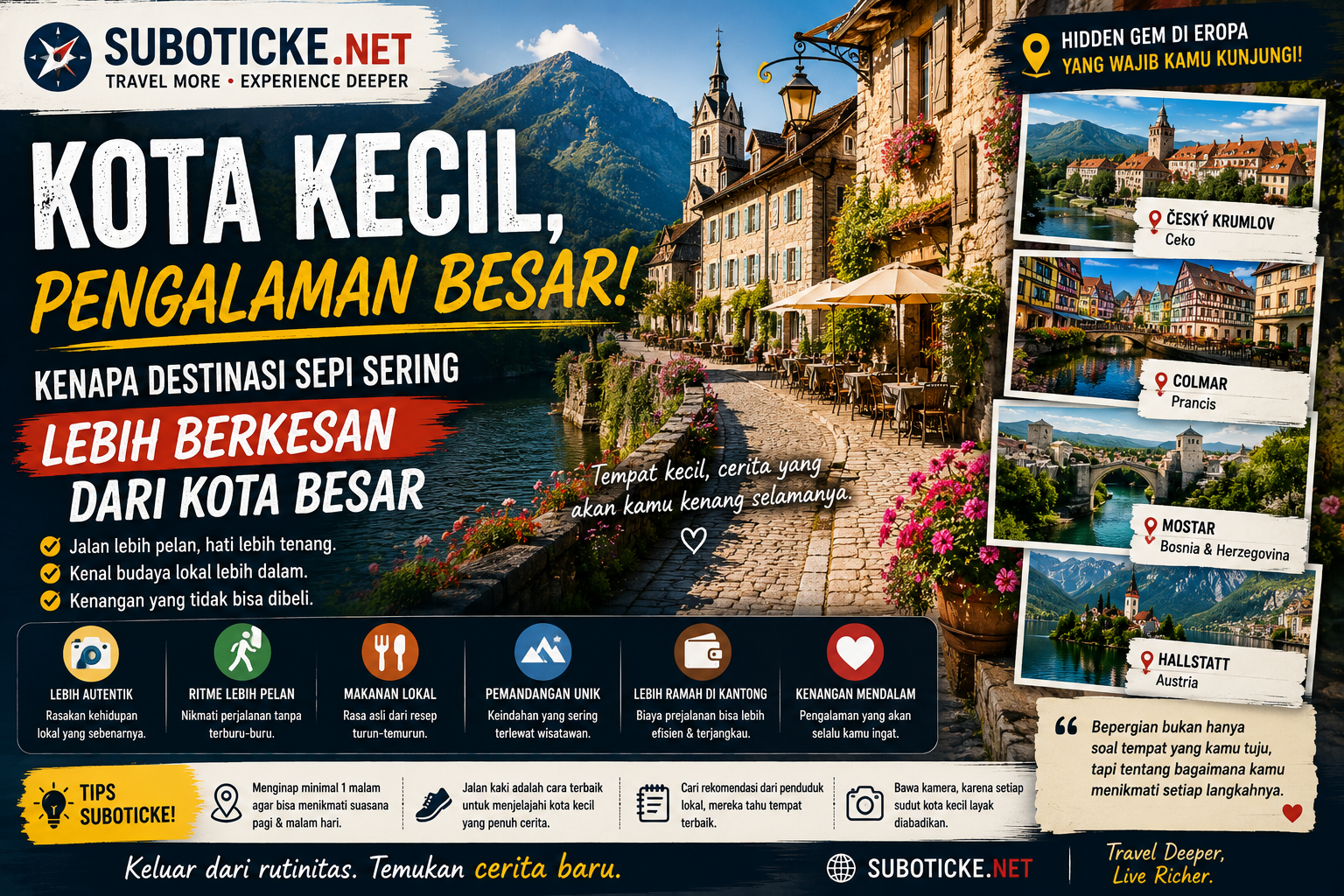
Banyak destinasi kota kecil di Eropa menawarkan pengalaman yang berbeda dari ibu kota atau pusat wisata besar. Kota-kota seperti Český Krumlov di Ceko, Colmar di Prancis, Hallstatt di Austria, Mostar di Bosnia dan Herzegovina, hingga berbagai kota kecil di kawasan Balkan dan Eropa Tengah memiliki karakter yang kuat meskipun ukurannya tidak besar. Daya tarik utamanya sering bukan jumlah atraksi, melainkan suasana, arsitektur, makanan lokal, dan kesempatan untuk menjelajahi tempat dengan ritme yang lebih santai.
Namun ada satu hal penting:
kota kecil yang viral juga bisa menjadi sangat ramai.
Jadi “kecil” tidak otomatis berarti “sepi.”
Český Krumlov


Kota di Republik Ceko ini seperti keluar dari ilustrasi buku.
Old town.
River.
Castle.
Red rooftops.
Street kecil.
Kalau datang dari Prague:
atmosphere langsung berubah.
Daya Tariknya Ada pada Skala
Kita tidak membutuhkan kendaraan untuk terus berpindah.
Banyak bagian menarik bisa dinikmati dengan berjalan kaki.
Keluar dari hotel.
Walk.
Coffee.
Castle.
River.
Lunch.
Walk lagi.
Simple.
Tapi Jangan Hanya Datang Day Trip
Ini kesalahan umum di destinasi kecil.
Bus wisata datang pagi.
Ramai.
Sore:
semua pulang.
Traveler yang menginap mendapat sisi kota berbeda.
Morning dan evening sering lebih tenang.
Colmar


Colmar di Alsace terkenal karena:
colorful houses.
canals.
cobblestone streets.
Old European architecture.
Fotogenik?
Banget.
Tapi jangan cuma datang untuk foto.
Alsace Punya Identitas yang Menarik
Posisinya dekat perbatasan Jerman membuat kawasan ini punya kombinasi pengaruh budaya yang khas.
Arsitektur.
Food.
Language history.
Wine culture.
Semua terasa berbeda dari bayangan stereotypical tentang Prancis.
Little Venice
Salah satu area paling dikenal di Colmar.
Canal.
Traditional houses.
Flowers.
Bridge.
Beautiful.
Tetapi:
popular.
Datang pagi kalau ingin suasana lebih calm.
Kota Kecil Mengajarkan Timing
Attraction mungkin sama.
Pengalaman bisa berbeda total.
Jam 11:
tour group.
Jam 7 pagi:
orang lokal membuka toko.
Jam 9 malam:
jalan mulai tenang.
Travel isn’t only where.
It’s also when.
Hallstatt
Hallstatt adalah contoh menarik.
Secara visual:
extraordinary.
Lake.
Mountain.
Traditional houses.
Church.
Tiny settlement.
Tapi popularitasnya membuat kota kecil ini bisa mengalami overtourism.
Viral Destination Paradox
Orang mencari:
hidden gem.
Kemudian jutaan orang menemukan hidden gem yang sama.
Tidak hidden lagi.
Social media mempercepat siklus ini.
Jadi Haruskah Menghindari Hallstatt?
Tidak.
Justru kita perlu:
manage expectation.
Stay overnight.
Visit shoulder season.
Explore surrounding region.
Jangan menganggap seluruh experience hanya satu viewpoint Instagram.
Lake Region Lebih Luas dari Satu Spot
Kesalahan travel:
datang ke lokasi terkenal.
Foto.
Pergi.
Padahal landscape sekitarnya bisa jauh lebih menarik.
Explore region, not pin.
Mostar


Mostar punya karakter berbeda.
Bukan fairy-tale pastel.
Lebih raw.
Lebih historis.
Stari Most menjadi landmark paling terkenal.
Tetapi kota ini juga membawa sejarah kompleks kawasan Balkan.
Travel Bisa Menjadi Pintu Masuk ke Sejarah
Sebelum datang:
kita mungkin hanya tahu bridge.
Setelah membaca:
Ottoman influence.
Yugoslavia.
Bosnian War.
Reconstruction.
Identity.
Satu kota kecil membuka satu bab sejarah.
Jangan Datang Hanya untuk Foto Bridge
Travel becomes richer ketika kita memahami:
apa yang kita lihat.
Architecture without context:
pretty.
Architecture with context:
story.
Perast Montenegro
Bayangkan:
Bay of Kotor.
Mountains.
Stone buildings.
Water.
Small waterfront town.
Perast jauh lebih kecil dibanding banyak destinasi terkenal Eropa.
Dan itu justru kelebihannya.
Tidak Banyak yang Harus “Dilakukan”
Sounds negative.
Actually:
that’s the appeal.
Walk waterfront.
Eat.
Boat.
Coffee.
Watch sunset.
Done.
Productivity Mindset Bisa Merusak Travel
Kita terbiasa berpikir:
berapa banyak?
Berapa tempat?
Berapa foto?
Berapa aktivitas?
Padahal vacation bukan KPI.
Kadang satu sore melihat laut sudah cukup.
Kotor Ada di Dekatnya
Kalau ingin lebih ramai:
Kotor.
Kalau ingin lebih slow:
Perast.
Kombinasi dua tempat membuat itinerary lebih balanced.
Rovinj Croatia
Coastal town.
Old buildings.
Adriatic.
Narrow lanes.
Mediterranean atmosphere.
Rovinj punya visual identity kuat tanpa scale sebesar kota metropolitan.
Old Town-nya Cocok untuk Tersesat
Literally.
Street kecil.
Turn left.
Stairs.
Gallery.
Sea view.
Tidak semua perjalanan perlu navigasi presisi.
liburan ke kota kecil
Saat merencanakan liburan ke kota kecil, jangan membuat itinerary seperti ketika mengunjungi metropolis. Sisakan waktu kosong untuk berjalan tanpa tujuan, mengunjungi pasar, mencoba makanan lokal, duduk di ruang publik, dan melihat bagaimana aktivitas sehari-hari berlangsung. Kota kecil sering tidak memiliki puluhan landmark besar, sehingga pengalaman terbaik justru muncul dari suasana dan interaksi dengan tempat tersebut.
Ini perbedaan penting.
Kota besar:
attraction-driven.
Kota kecil:
atmosphere-driven.
Ljubljana Memang Ibu Kota Tapi Terasa Intimate
Slovenia’s capital technically bukan small town.
Tapi dibanding Paris atau London:
scale terasa jauh lebih manageable.
Compact center.
River.
Cafe.
Green spaces.
Pedestrian-friendly areas.
Good example bahwa ukuran administrasi tidak selalu menentukan feel.
Lake Bled Bisa Dikombinasikan
Ljubljana + Bled.
City + nature.
Shorter distances.
Slovenia cocok untuk traveler yang tidak ingin menghabiskan trip hanya berpindah kota besar.
Bled Sendiri Sangat Populer
Again:
small ≠ undiscovered.
Lake.
Island church.
Castle.
Mountain backdrop.
Classic.
Walk Around the Lake
Daripada hanya datang ke viewpoint:
walk.
Perspective berubah terus.
Travel experience becomes physical, not only visual.
Ohrid North Macedonia
Lake Ohrid.
Historic churches.
Old town.
Mountain scenery.
Waterfront.
Kota ini memberikan kombinasi:
history + nature + slower rhythm.
Lake Ohrid Sangat Tua
Kawasan danau punya significance ekologis dan budaya yang besar.
Ini membuat Ohrid bukan hanya:
“tempat cantik.”
Ada depth.
Stay Longer
Tempat seperti Ohrid cocok untuk:
2–3 nights.
Tidak perlu attraction hopping.
Morning coffee.
Lake.
Old town.
Dinner.
Repeat slower.
Berat Albania
Salah satu kota historis Albania.
Distinctive Ottoman-era architecture.
Houses climbing hillside.
Old quarters.
Castle.
Visualnya langsung recognizable.
Albania Menjadi Semakin Populer
Dulu sering dianggap off-the-beaten-path.
Sekarang:
travel interest meningkat.
Ini menunjukkan hidden destination status selalu berubah.
Gjirokastër
Masih Albania.
Stone city.
Hills.
Traditional architecture.
Castle.
Different character from coastal Albania.
Jangan Hanya Mengejar Pantai Albania
Coastline memang terkenal.
Tapi inland towns memberi cultural dimension berbeda.
Sibiu Romania
Old town.
Squares.
Colorful buildings.
Transylvanian context.
Dan terkenal dengan roof windows yang terlihat seperti:
“eyes.”
Architecture Membuat Personality
Ada kota yang kita ingat karena landmark.
Ada kota yang kita ingat karena:
texture.
Sibiu termasuk yang kedua.
Brașov
Lebih terkenal.
Tetapi masih manageable.
Mountains.
Old center.
Good base untuk exploring Transylvania.
Base Town Strategy
Tidak harus pindah hotel setiap hari.
Pilih satu kota kecil/medium sebagai base.
Day trip.
Return.
Less packing.
Less transport stress.
Slow Travel Bisa Lebih Hemat
Sering pindah kota berarti:
train.
bus.
taxi.
check-in.
luggage storage.
Time cost.
Stay longer bisa mengurangi friction.
Tapi Accommodation Price Tetap Harus Dibandingkan
Small tourist town tidak otomatis murah.
Hallstatt?
Bisa mahal.
Famous coastal town?
Peak season expensive.
Research.
Popularity Matters More Than Size
Tiny destination + huge demand:
expensive.
Large city + many accommodation options:
sometimes cheaper.
Don’t assume.
Shoulder Season Adalah Sweet Spot
Peak summer:
crowd.
heat.
high prices.
Winter:
some places quiet/closed.
Spring/autumn sering balance.
But weather varies.
Weather Bisa Mengubah Kota Kecil Lebih Drastis
Di kota besar:
rain?
Museum.
Mall.
Cinema.
100 options.
Small town:
outdoor plan mungkin dominan.
Backup matters.
Check Seasonal Closures
Restaurant.
Boat.
Museum.
Tour.
Some small destinations operate seasonally.
Public Transport Bisa Lebih Jarang
Ini trade-off.
City:
metro every few minutes.
Village:
bus every 2 hours.
Miss one:
problem.
Always Check Last Bus
Seriously.
Especially day trips.
“Google Maps bilang ada.”
Check current operator schedule.
Renting Car Can Make Sense
For rural/small-town itinerary:
car gives flexibility.
But:
parking,
insurance,
local driving rules,
old-town restrictions.
Consider full cost.
Train Travel Can Be Beautiful
Some routes are part of experience.
Window.
Countryside.
Mountains.
Travel time isn’t always wasted.
Bus Sometimes Connects Small Towns Better
Rail network varies by country.
Don’t insist train because “European aesthetic.”
Choose practical.
One-Bag Travel Helps
Cobblestones + giant suitcase:
bad combination.
Old town hotel:
maybe stairs.
Pack light.
Wheels Hate Cobblestones
Anyone who dragged suitcase through European old town understands.
Small Hotels Can Feel More Personal
Family-run guesthouse.
Pension.
B&B.
Sometimes owner gives:
restaurant recommendation.
local route.
hidden viewpoint.
This interaction can become memorable.
But Review Facilities
Historic building may mean:
no elevator.
small bathroom.
limited AC.
Charm has trade-offs.
Don’t Expect Chain-Hotel Standardization
That’s part of experience.
But know before booking.
Local Breakfast
Small accommodation sometimes serves regional food.
Take advantage.
Travel through food.
Food Is One of the Best Reasons to Visit Smaller Places
Regional dishes can be stronger outside internationalized city centers.
Family recipes.
Local produce.
Traditional restaurant.
Menu Might Be Smaller
Good.
A restaurant doing 12 dishes well can beat one offering 90.
Ask What’s Local
Not:
“What’s popular?”
Ask:
“What is typical here?”
Different question.
Eat Seasonal
Local ingredient.
Regional preparation.
Food becomes geography.
Markets Reveal Everyday Life
Fruit.
Cheese.
Bread.
Meat.
Flowers.
Not designed primarily as attraction.
That’s valuable.
Visit Morning Market Early
Later:
closing.
Morning gives more activity.
Respect Vendors
Don’t photograph faces/products endlessly without buying or asking.
Market isn’t free photo studio.
Learn a Few Words
Hello.
Thank you.
Please.
Even if pronunciation bad:
effort matters.
English May Be Less Common
Especially older generation or rural areas.
Translation app useful.
Patience more useful.
Don’t Get Frustrated
You’re visitor.
Communication is shared improvisation.
Smile.
Gesture.
Translate.
Works surprisingly often.
Cash Can Matter More
Small businesses may not accept every card/payment method.
Carry reasonable local cash.
But check current local practices.
ATM Planning
Smaller town may have fewer choices.
Withdraw before remote area if needed.
Pharmacy Hours
In city:
many.
Small town:
limited.
Carry basics.
Sunday Can Be Very Quiet
Depending country.
Shops close.
Restaurant schedule changes.
Research.
Local Holidays Matter
Town festival?
Amazing.
Or everything closed?
Both possible.
Check calendar.
Festival Can Transform Destination
Small town festival feels intimate.
Music.
Food.
Tradition.
Community.
Potential highlight.
But Accommodation Can Sell Out
Book earlier around events.
Nightlife Is Different
Don’t expect club until 4 AM everywhere.
Some towns:
quiet after dinner.
If nightlife priority:
choose destination accordingly.
Quiet Can Be the Luxury
No traffic.
No crowds.
Window open.
Church bell.
Morning birds.
For city residents:
this itself is experience.
Early Morning Walk
One of the best activities.
Before day-trippers arrive.
Empty streets.
Soft light.
Local routines.
Free.
Golden Hour
Small-town architecture loves warm light.
Stone.
Pastel facade.
Roof.
Photography becomes easy.
Blue Hour
Street lamps.
Old buildings.
Quiet square.
Different mood.
Stay One Night Just for Light
Day-trip-only visitors often miss:
sunrise.
night.
This is strong reason to sleep there.
Photography Changes When Crowd Leaves
Tripod maybe possible.
Composition cleaner.
But don’t block locals.
Social Media Can Misrepresent Scale
Photo:
empty alley.
Reality:
300 tourists behind photographer.
Set expectations.
Search Recent Videos
They reveal:
crowd.
construction.
weather.
Reality better than curated photo.
Don’t Let Crowd Automatically Ruin Destination
Popular places are popular for reason.
Strategy:
timing.
Wake Earlier
Cheapest anti-crowd hack.
Walk 10 Minutes Away from Main Square
Crowd can disappear quickly.
Tourists cluster.
Main Street Is Not Entire Town
Side streets often more interesting.
But Don’t Trespass
Residential lane:
public? okay.
Private courtyard?
respect.
Local Residents Aren’t Attraction
Obvious but worth saying.
Overtourism Hits Small Towns Harder
A city of millions absorbs visitors.
Village of 700?
Thousands of tourists dramatically change daily life.
Travel Responsibly
Stay overnight.
Eat local.
Use local guide.
Buy from local businesses.
Not only arrive-tour-photo-leave.
Tourism Money Distribution Matters
Bus tour may contribute less locally than independent overnight visitor.
Support destination, not just consume it.
Water Usage Can Matter
Especially islands/coastal destinations.
Be mindful.
Waste Is More Visible
Small places may have limited infrastructure.
Reusable bottle/bag helps.
Hiking Around Small Towns
Many European towns sit near:
mountain.
vineyard.
lake.
forest.
Walking routes add another layer.
Urban + Nature Combo
Morning old town.
Afternoon trail.
Dinner local.
Great itinerary.
Ask Tourist Office
Underrated.
Local maps.
Walking routes.
Events.
Current closures.
Often free.
Tourist Offices Know Things Blogs Don’t
Festival today.
Trail closed.
Free concert tonight.
Use them.
Printed Maps Are Still Useful
Especially small towns.
Phone away.
Walk.
Getting Lost Is Easier When Stakes Are Low
Small old town.
Eventually you find main square again.
Enjoy.
Sit in the Main Square
Don’t just photograph.
Coffee.
Observe.
People-Watching Is Travel
Kids.
Cyclists.
Locals greeting.
Delivery van.
Daily rhythm.
Architecture Needs Time
Door.
Window.
Roof.
Sign.
Stone.
Small details disappear when rushing.
Church Isn’t Just Photo Stop
Look at history.
Architecture.
Community role.
Respect worship.
Cemetery Can Reveal History
If open to visitors and culturally appropriate.
Names.
Dates.
Language.
But behave respectfully.
Small Museums Can Be Surprisingly Good
Local history.
Industry.
Folk culture.
Specificity.
Not every museum needs Louvre scale.
Local Story > Huge Collection Sometimes
A tiny museum explaining one town deeply can be memorable.
Industrial Heritage
Not all pretty medieval streets.
Mining towns.
Factory towns.
Railway towns.
Interesting too.
Travel Doesn’t Need to Be Instagram-Beautiful
Historical significance can be enough.
Brutalist Towns Can Be Fascinating
Architecture lovers see beauty differently.
Former Yugoslav Region Has Rich Urban Layers
Ottoman.
Austro-Hungarian.
Yugoslav modernism.
Post-socialist change.
Multiple histories visible.
This Is Why Balkan Travel Is Interesting
Not only cheap prices.
Cultural complexity.
Avoid Reducing Destinations to “Cheap Europe”
People live there.
History exists.
Travel content should go deeper.
Learn Basic History Before Arrival
30 minutes reading changes what you notice.
Local Guide Can Add Depth
Especially places with:
war history.
ethnic complexity.
religious history.
Nuance matters.
Don’t Treat Complex History Like Entertainment
Be respectful.
Memory Sites Require Different Behavior
No silly poses.
Read.
Listen.
Travel Can Challenge Simplistic Narratives
Places rarely fit one headline.
Good.
Smaller Places Encourage Conversation
Cafe owner asks where you’re from.
Guesthouse host talks.
Bus passenger helps.
More likely when environment isn’t rushed.
Not guaranteed.
Don’t Force Interaction
Locals don’t owe travelers conversation.
Let it happen naturally.
Solo Travel Can Feel Different
Small town:
quiet.
Could feel peaceful.
Could feel lonely.
Know yourself.
Bring a Book
Perfect small-town accessory.
Cafe.
Lake.
Park.
Couples Often Love Slow Destinations
Less logistics.
More time together.
Family Travel
Compact center can be easier.
But stroller + cobblestone:
check.
Older Travelers
Walking slopes.
stairs.
accessibility.
Research terrain.
Pretty hill town may be physically demanding.
Accessibility Information Can Be Limited
Contact accommodation directly if needed.
Shoes Matter
Cobblestone.
Hill.
Trail.
Comfort > outfit.
Layer Clothing
Weather changes.
Mountain towns especially.
Small Umbrella
Classic travel item.
Water
Not every trail has shop.
Download Offline Map
Signal may weaken outside center.
Save Accommodation Address
Old town streets can have confusing naming/entrances.
Check Check-In Time
Small guesthouse may not have 24-hour reception.
Important.
Tell Host Arrival Time
Especially late.
Don’t Assume Taxi Is Always Available
Small town late night?
Maybe none.
Plan station transfer.
Day Trip vs Overnight
Ask:
Does town change after day-trippers leave?
If yes:
overnight.
Two Nights Can Be Better
Night 1:
arrive.
Day 2:
full day.
Night 2:
relax.
Less rushed.
Three Nights If Nature Nearby
Use town as base.
Don’t Change Hotel Daily
Packing fatigue is real.
Slow Travel Reduces Decision Fatigue
Same room.
Same cafe maybe.
You develop tiny routine.
Repetition Can Make Place Feel Familiar
Second morning:
barista recognizes you.
Small moment.
Familiarity Is Different from Sightseeing
That’s why longer stays feel richer.
You Start Noticing Change
Morning market vs evening square.
Weekday vs weekend.
Weather.
Travel Memory Benefits from Depth
Ten cities in ten days:
blur.
Three cities:
distinct.
Not universal, but common.
Quantity Isn’t Automatically Better
Passport stamps aren’t experience score.
FOMO Drives Fast Travel
“Since we’re nearby, let’s add another country.”
Then half trip on train.
Transport Day Is Still a Day
Count it honestly.
Map Distance Can Deceive
150 km might require:
4 hours.
Mountain road.
Transfers.
Border.
Check real travel time.
Border Crossings in Balkans Can Add Time
Depends route, season, current procedures.
Build buffer.
Don’t Book Tight Connections
Especially international bus.
EU/Schengen Isn’t Entire Europe
Border rules differ.
Verify current requirements for nationality/passport.
Currency Isn’t Always Euro
Czech koruna.
Bosnia and Herzegovina convertible mark.
Albanian lek.
Serbian dinar.
Etc.
Check destination.
Small Purchases Need Currency Familiarity
Learn rough conversion.
Avoid accidental overspend.
Don’t Assume Cards Everywhere
Again.
Backup.
Tipping Customs Differ
Research country.
Don’t apply US norms automatically.
Restaurant Service Pace May Differ
Slow meal can be cultural rhythm.
Not bad service necessarily.
Dinner Time Varies
Spain vs Balkans vs Central Europe.
Adapt.
Shops May Close Midday
Some regions/businesses.
Plan.
Siesta-Type Rhythms Exist in Certain Places
Not everywhere.
Observe.
Sunday Transport Can Be Reduced
Always check.
Winter Travel
Beautiful.
Christmas markets.
Snow.
Fewer crowds.
But:
short daylight.
closures.
weather disruption.
Summer
Long days.
Festivals.
Outdoor dining.
But:
heat.
crowds.
higher price.
Autumn
Color.
harvest.
wine regions.
Potentially great.
Spring
Flowers.
mild weather.
But rain.
Every season trade-off.
Wine Towns
Small European wine regions offer:
vineyards.
cellars.
food.
walking.
Different travel rhythm.
Don’t Drink and Drive
Obvious.
Use designated transport/tours.
Local Food Experiences Don’t Need Fine Dining
Bakery.
Market.
Family restaurant.
Cheese shop.
Breakfast Can Tell a Story
Bread style.
Cheese.
Meat.
Coffee.
Regional identity.
Supermarket Visit Is Surprisingly Fun
What snacks?
Prices?
Local products?
Everyday culture.
Buy Picnic Food
Bread.
Fruit.
Cheese.
Park/lake.
Budget-friendly.
Follow local rules about public spaces/alcohol.
Picnic Also Slows You Down
No reservation.
No rush.
Local Dessert Mission
Choose one regional sweet.
Find best version.
Simple travel game.
Travel Themes Make Small Towns More Interesting
Architecture day.
Food day.
Photography.
History.
Nature.
Instead of attraction checklist.
Create Your Own Walking Route
Start station.
Market.
Old town.
River.
Hill.
Dinner.
Ask One Question Per Destination
Example:
Why do houses look like this?
Now travel becomes investigation.
Read Signs
Historical plaques.
Building dates.
Street names.
Free information.
Street Names Carry History
People.
events.
geography.
Local Language Signs Give Character
Even if can’t read:
translation app.
Bookstore
Great place to see local culture.
Postcards.
Maps.
Books.
Postcards Still Work
Send one home.
Old-school memory.
Local Craft
Better souvenir than generic magnet if authentic and within budget.
Beware Mass-Produced “Local” Souvenirs
Ask origin if important.
Buy Consumable Souvenirs
Tea.
spice.
food where import rules permit.
Less clutter.
Check Customs Rules
Especially meat/dairy/plants when returning internationally.
Photos + Journal
Best lightweight souvenirs.
Write One Paragraph Each Night
What surprised you?
What smelled good?
What sounded different?
Specific memories survive.
Don’t Only Photograph Landmarks
Hotel window.
Breakfast.
Bus ticket.
Rain.
Small moments later become nostalgic.
Back Up Photos
Cloud/Wi-Fi.
Losing trip photos hurts.
But Don’t Experience Everything Through Camera
Take photo.
Then phone down.
Look.
Some Views Need No Photo
Memory is enough.
Sunrise Can Be Worth It
Small town rooftops.
Fog.
Empty street.
But sleep matters.
Not every day.
Sunset Is Easier
Dinner afterward.
Night Walk
If area is safe/current conditions permit.
Quiet old town can feel completely different.
Street Lighting Changes Architecture
Warm lamps.
Stone walls.
Shadow.
Atmosphere.
Safety
Small doesn’t automatically mean zero crime.
Normal precautions.
Tourist Scams Can Exist Anywhere
Research common issues.
Keep Documents Secure
Standard travel practice.
Insurance
Especially if hiking/driving.
Coverage matters.
Driving in Old Town
Often restricted.
Don’t blindly follow GPS into pedestrian zone.
ZTL-Type Restrictions
Some European cities/towns restrict vehicles in historic centers.
Fines can arrive later.
Check signs/local rules.
Parking Outside Old Town Can Be Easier
Walk in.
Rental Car Size
Smaller car often better for:
narrow roads.
parking.
old streets.
Manual Transmission
Common in European rental fleets historically, though automatics increasingly available.
Book correct type.
Fuel Rules
Return full?
Prepaid?
Read contract.
Cross-Border Rental
Need permission in some cases.
Especially multi-country Balkan itinerary.
Verify.
Train Reservations
Some routes require.
Others don’t.
Current operator source best.
Bus Tickets
Sometimes online.
Sometimes station.
Sometimes driver.
Varies.
Never Assume Blog Fare Is Current
Travel information changes.
That’s Why Evergreen Advice Focuses on Strategy
Timing.
Planning.
Respect.
Pace.
These remain useful.
How to Choose a Small Town
Ask:
What do I enjoy?
History?
Nature?
Food?
Photography?
Beach?
Wine?
Then choose.
Not:
“What’s trending?”
Choose Based on Route Too
Beautiful town 8 hours detour:
maybe not worth.
Another great town directly on route:
better.
Travel Logistics Are Part of Destination Quality
Hard-to-reach isn’t automatically more authentic.
Hidden Gem Obsession Can Become Silly
People travel 6 hours just to avoid tourists.
Then complain there’s no infrastructure.
Balance.
Popular Destination Can Still Be Excellent
Colmar.
Hallstatt.
Český Krumlov.
Popular doesn’t mean bad.
Lesser-Known Doesn’t Mean Good
Some places are less visited because:
there isn’t much for your interests.
Research.
Authenticity Is Complicated
Tourist restaurant can be locally owned.
Popular square can still be historical.
Don’t chase purity.
Better Goal: Meaningful Experience
Learn.
Enjoy.
Respect.
Support local economy.
Don’t Compare Every Town
“This isn’t as pretty as…”
Let each place be itself.
Travel Expectations Shape Satisfaction
Instagram sets impossible standard.
Reality has:
cars.
construction.
trash collection.
bad weather.
That’s normal.
Towns Are Living Places
Not movie sets.
Laundry Hanging from Windows Can Be More Real Than Perfect Facade
Daily life adds character.
School Run.
Delivery.
Old people chatting.
Dogs.
Normal life.
That’s destination too.
Sit Somewhere Without Doing Anything
Try 20 minutes.
No phone.
Observe.
Harder than it sounds.
Boredom Can Open Attention
At first:
nothing happening.
Then you notice:
everything.
Slow Travel Is Attention Training
That’s perhaps its biggest value.
We Remember Feelings More Than Checklists
How morning felt.
Cafe smell.
Cold air.
Church bell.
Conversation.
Not exact sequence of 17 landmarks.
A Small Town Gives Memory Room
Less sensory competition.
Big Cities Can Do This Too
Of course.
Slow travel is mindset, not population number.
But small towns make it easier.
Don’t Romanticize Small-Town Life
Visitor sees beauty.
Resident experiences:
jobs.
transport limits.
seasonality.
housing.
Different perspective.
Travel gaze is temporary.
Respect That Difference
Don’t say:
“I wish life were always this simple.”
Maybe it isn’t.
Tourism Can Raise Housing Pressure
Especially popular historic towns.
Responsible tourism conversation matters.
Stay in Legal Accommodation
Support regulated local economy.
Avoid Disturbing Residential Buildings
Late-night noise.
Suitcase wheels.
Parties.
Quiet Hours Matter
Small old streets amplify sound.
Learn Local Waste Rules If Staying Apartment
Recycling systems differ.
Refill Water Where Safe
Check local guidance.
Reduce Single-Use Purchases
Easy.
Use Public Transport Where Practical
Less parking pressure.
Walk
The most natural small-town transport.
Rent Bicycle
Some areas perfect.
But follow traffic rules.
Helmet/safety.
E-Bike Expands Range
Hills become manageable.
Check rental terms.
Don’t Underestimate Mountain Weather
Sunny town.
Storm on trail.
Check forecast.
Trail Difficulty
Distance isn’t enough.
Elevation.
terrain.
exposure.
Tell Someone Route for Remote Hikes
Standard safety.
Proper Footwear
Old town sneakers.
Mountain trail maybe hiking shoes.
Small-Town + Nature Trip Requires Flexible Packing
Layer.
rain shell.
comfortable footwear.
Carry Less Overall
Again.
Mobility matters.
One Week Example
Instead of:
Paris → Brussels → Amsterdam → Cologne → Zurich.
Could do:
one region.
2–3 bases.
Day trips.
Deeper experience.
Regional Travel Has Coherence
Food changes gradually.
Architecture.
Language.
Landscape.
You understand region.
Country Counting Doesn’t
Seven flags.
Little context.
Train Window Becomes Part of Story
Fields.
villages.
mountains.
Border Regions Are Especially Interesting
Alsace.
Istria.
Balkans.
Cultural mixing.
Food Shows Borders Are Porous
Recipes travel.
Names change.
Ingredients overlap.
Architecture Shows Empires and Trade
History visible.
Language Shows Layers Too
Place names can have multiple versions.
Interesting.
Research Pronunciation
Locals appreciate effort.
Don’t Correct Locals Based on Google
Obviously.
Ask How They Say It
Conversation starter.
Tourist Information Can Be Multilingual
Use.
Local Blogs Can Offer Better Tips
Translate page.
But verify freshness.
Maps Reviews Help Find Food
Sort recent.
Look at local-language reviews too if possible.
Avoid Only Highest-Rated Place
Rating bias.
New place with fewer reviews may be excellent.
Walk Past Restaurants
See:
menu.
crowd.
smell.
Sometimes analog discovery wins.
Eat Where Menu Fits Place
If tiny Balkan town restaurant offers:
sushi + tacos + pizza + curry + burgers + local food…
maybe question it.
Not always bad.
Just signal.
Ask Host
Often best.
But Host Recommendation May Be Friend/partner Business
Still can be good.
Use judgment.
Don’t Optimize Every Meal
Random meal can surprise.
Travel Needs Serendipity
Leave space.
Small Town Is Perfect for No-Plan Afternoon
This should be on itinerary:
“nothing.”
Cafe for Two Hours
Read.
Write.
People-watch.
No guilt.
Vacation Doesn’t Need Productivity
Workation Is Different
If working:
check Wi-Fi.
desk.
quiet.
Small towns may vary.
Mobile Data Backup
Useful.
Cafe Laptop Etiquette
Don’t occupy tiny cafe all day during rush.
Buy appropriately.
Local Coworking May Exist in Medium Towns
Check.
Digital Nomad Popularity Can Change Prices
Another tourism impact.
Balance Visitor Needs with Community
Recurring theme.
Why Small Destinations Feel Personal
Because repeated encounters happen.
Same street.
Same cafe.
Same shopkeeper.
Scale creates familiarity.
Familiarity Builds Attachment
After three days:
you have favorite bakery.
That’s powerful.
You Begin Giving Directions Mentally
“Hotel is after the blue house.”
Place becomes internal map.
This Is Different from Landmark Consumption
You inhabit temporarily.
Travel Isn’t Only Seeing
It’s briefly learning how to move through somewhere.
The Best Destinations Aren’t Always the Ones With Most Attractions
Sometimes they’re the ones where you:
feel comfortable staying.
Ask Yourself After Trip
Where would I return for a week?
Answer may surprise.
Famous City Might Impress More
Small town might make you happier.
Different metrics.
Travel Planning Should Account for Mood
Want energy?
Big city.
Want decompression?
Small town/nature.
Mix Both
This may be ideal.
Three nights city.
Three nights small town.
Contrast Makes Each Better
After quiet town:
city feels exciting.
After city:
quiet feels luxurious.
Avoid 100% Same Rhythm
Unless that’s what you want.
Suboticke.net Travel Philosophy
This is a good direction for the site:
not only “10 places to visit.”
But explaining:
how places feel and how to experience them better.
That’s more useful and less generic.
Quick Checklist Sebelum Memilih Kota Kecil
Check:
transport.
accommodation.
season.
weather.
opening hours.
payment.
activities.
terrain.
internet if needed.
Then leave some things unknown.
Don’t Research Away All Surprise
Know enough to avoid problems.
Not enough to script every minute.
Three Questions
Can I reach it easily?
Is there enough for 1–3 nights?
Does it fit what I actually enjoy?
If yes:
go.
Jangan Memilih Hanya Karena Foto
Pretty place can bore you if interests don’t match.
History Lover
Choose historical town.
Food Lover
Regional culinary center.
Nature Lover
Lake/mountain base.
Beach Lover
Coastal town.
Photographer
Architecture + light + walkability.
Writer
Quiet cafe + atmosphere.
Everyone’s “Hidden Gem” Is Different
That’s good.
Conclusion
Kota besar akan selalu punya daya tarik.
Ada alasan kenapa jutaan orang ingin melihat Paris, Rome, London, Amsterdam, atau Barcelona.
Mereka punya:
museum luar biasa,
arsitektur,
makanan,
sejarah,
dan energi yang sulit ditemukan di tempat lain.
Tetapi perjalanan tidak harus selalu tentang tempat dengan daftar attraction terpanjang.
Kadang kita justru membutuhkan kota yang hanya memberi beberapa pilihan.
Jalan kaki.
Makan.
Duduk.
Melihat.
Berbicara.
Tidur.
Bangun.
Lalu mengulanginya tanpa merasa sedang membuang waktu.
Kota-kota seperti Český Krumlov, Colmar, Mostar, Perast, Rovinj, Ohrid, Berat, Gjirokastër, Sibiu, dan banyak destinasi lain menunjukkan bahwa ukuran sebuah tempat tidak menentukan seberapa besar pengalaman yang bisa kita bawa pulang.
Justru ketika tidak ada terlalu banyak hal yang harus dikejar:
kita punya lebih banyak waktu untuk memperhatikan.
Suara jalan.
Detail bangunan.
Makanan lokal.
Perubahan cahaya.
Ritme orang yang tinggal di sana.
Dan mungkin itulah alasan kota kecil sering meninggalkan kesan yang tidak kita duga.
Kita datang karena berpikir:
“Cuma mampir satu malam.”
Lalu ketika waktunya pergi:
malah muncul pikiran,
“Kayaknya gue kurang lama di sini.”