
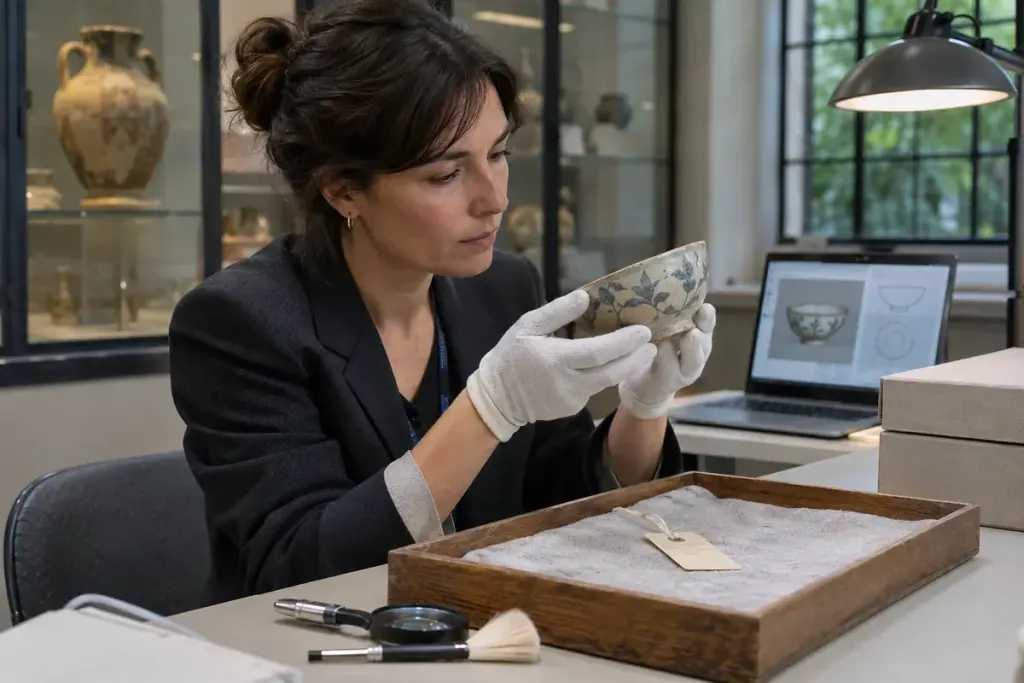
You remember a ceramic bowl from a museum visit, but its label changes and the photograph in your notes is incomplete. The object’s accession number may be the most useful detail you could have recorded.
Collections Trust’s numbering guidance describes the accession number as the unique identifier allocated when an object or group is formally acquired for a museum’s long-term collection. It connects the object with information held about it.
Copy the institution as well as the number
A number is meaningful within its collection system. Record the museum name beside it, including punctuation, prefixes and suffixes exactly as shown. A photograph can help, provided photography is allowed, but a typed note makes the identifier easier to search later.
Do not assume every number on a display is an accession number. An exhibition may also use an audio-guide stop, case number or temporary reference. If uncertain, ask staff which identifier belongs in a research enquiry.
Let the number lead to information
Collections Trust’s discussion of renumbering stresses that the code’s job is to link an object and its records. It need not describe the object’s subject or storage location. Trying to decode every digit can therefore be less productive than consulting the catalogue.
A practical enquiry might say: “I saw object [identifier] in the local-history gallery. Does the collection record identify the workshop or the place where it was used?” That gives staff a precise starting point and makes your research question visible.
Keep the catalogue’s wording alongside any interpretation you develop. “Attributed to” and “made by” express different levels of certainty. A location associated with acquisition is not automatically the place of manufacture.
When sharing your findings, include the collection reference and the date you consulted the record. Museum knowledge can develop through research, so a note should show which version of the information you used. The accession number does not answer every historical question, but it keeps the conversation attached to the same object as the labels, displays and interpretations around it change.