
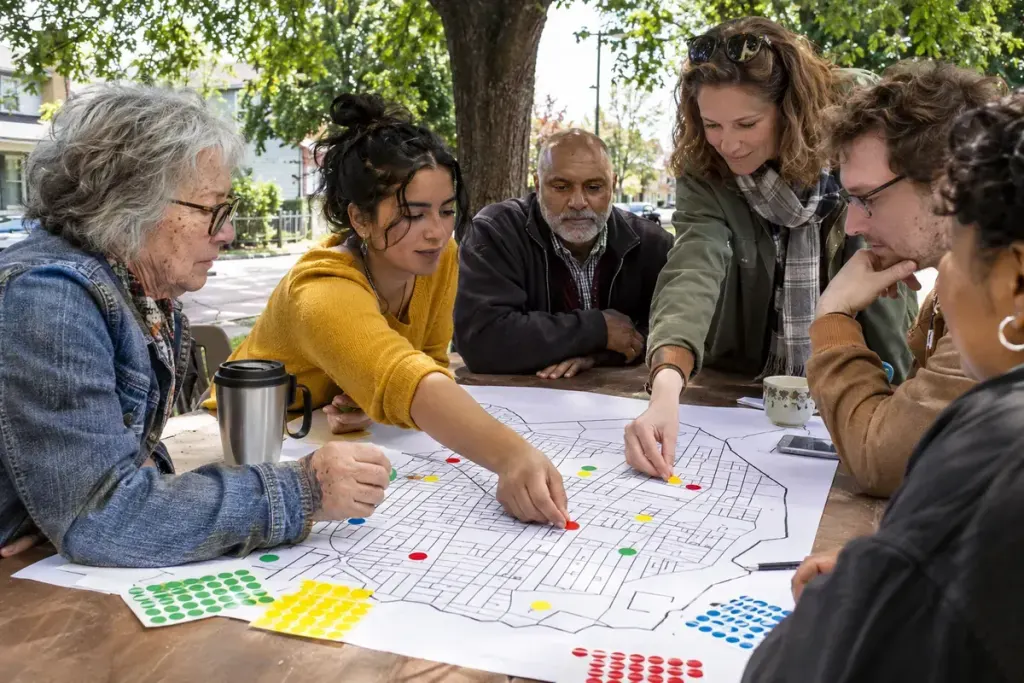
An official map may show every road while saying little about where neighbours actually meet, which path becomes difficult in winter or which public space feels welcoming. A community mapping exercise can add that lived knowledge without pretending to replace an authoritative survey.
The International Institute for Environment and Development’s participatory resource mapping toolkit describes a process through which people explain the resources they use, value and manage. It applies to urban as well as rural settings.
Give the map one clear question
“Map everything important” can overwhelm a first meeting. A more workable question might be: “Which places help residents spend time together?” Put a simple base map on the table, provide removable markers and let participants explain their choices.
In an illustrative exercise, one person marks a library entrance, another a shaded bench and another a small meeting room. The value lies partly in the discussion: opening times, steps at an entrance or the need to book may explain why a point matters.
Keep different experiences visible
A place can be convenient for one person and inaccessible to another. Do not erase the disagreement by averaging it into a single cheerful symbol. Record the conditions attached to each observation and invite people missing from the first session to respond.
The Forest Peoples Programme’s account of participatory mapping also highlights communities’ connections to places. Mapping can touch sensitive knowledge and claims, so publication should not be an automatic final step.
Before sharing the result, agree which details may be public. Avoid exposing a vulnerable person’s routine, private addresses or sensitive sites simply because someone mentioned them in a workshop. Separate a public map from any restricted notes.
Date the map, identify its purpose and describe who contributed without publishing unnecessary personal information. An annotation such as “reported by participants; not yet checked” preserves uncertainty. A useful community map is a record that can be questioned and updated, not a finished verdict on everyone’s experience.