
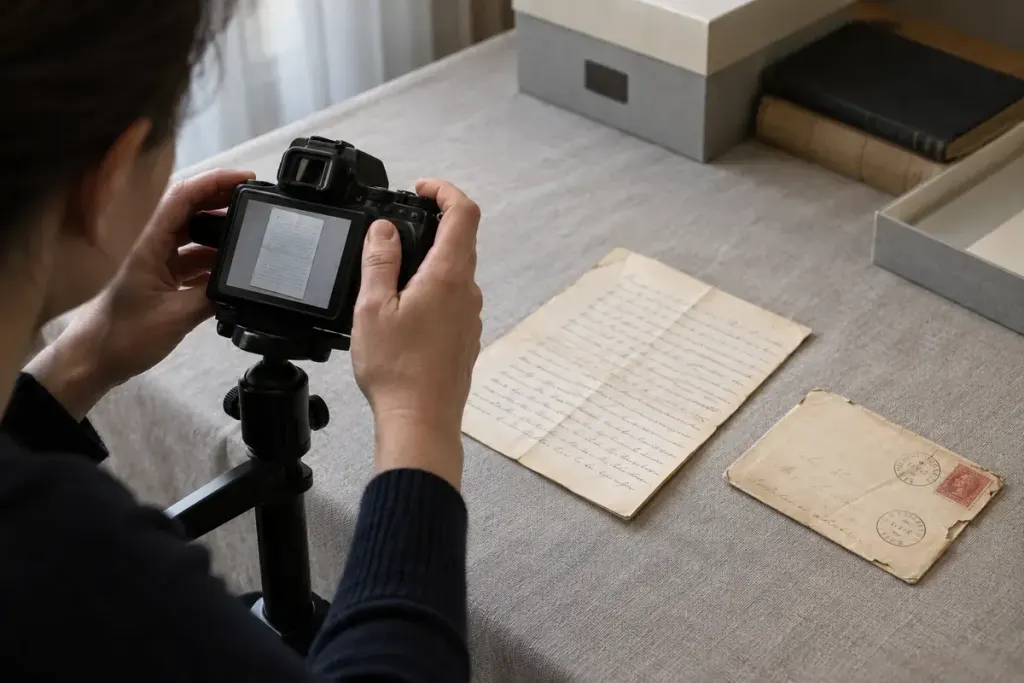
A letter’s message may be the reason it survives, but its envelope can explain how it travelled. Addresses, postmarks and annotations may provide clues that the writer did not repeat inside. Keep that relationship intact when making a digital copy for a family or community archive.
The Smithsonian National Postal Museum’s preservation guidance treats letters and their associated material as objects worth protecting. The US National Archives’ digitisation guidance also stresses keeping originals after scanning; digital files have preservation risks of their own.
Establish the sequence before scanning
Give the item a simple identifier. Photograph or scan the envelope front and back, followed by the letter’s pages in their existing order. If the order is uncertain, record that uncertainty rather than silently rearranging the pages into a guessed narrative.
For example, a folder might contain files labelled letter-014-envelope-front, letter-014-envelope-back and letter-014-page-01. The names preserve the association even if someone later views the files outside your chosen album software.
Handle fragile paper gently and avoid forcing folds flat. Do not feed valuable originals through an automatic document feeder. Seek conservation advice for material that is brittle, stuck together or otherwise unsafe to handle.
Write a short context note
- Who supplied the letter, and when?
- Which names and dates are clearly legible?
- Which identifications are family recollections rather than written evidence?
- Are there privacy reasons to restrict public sharing?
A transcription can make handwriting searchable, but keep it alongside the image rather than replacing it. Mark uncertain words instead of guessing confidently.
Before sharing, open every file and check that edges, small marks and both sides of the envelope are included. A modest, well-labelled digital record can preserve more historical value than a beautifully cropped image that has lost its context.