
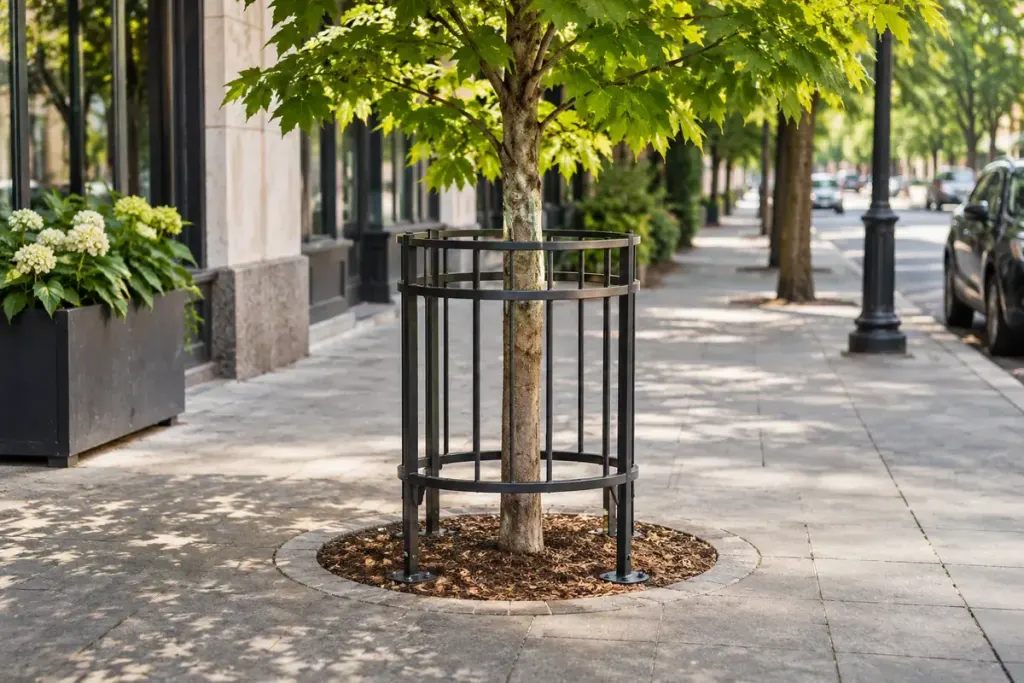
A metal guard can protect a young street tree from accidental knocks. Years later, the same tree may need more room. A fitting that once looked generous should not be assumed suitable for the tree’s entire life.
This is an ordinary maintenance issue with a visible clue: the relationship between the growing trunk and the fixed objects around it. Residents can help by reporting clear observations without trying to alter public tree equipment themselves.
Protection needs follow-up
The Arboricultural Association’s tree-care guidance explains the need to check supports and ties as trees grow and remove them when no longer needed. A guard, tie, or stake is part of an establishment arrangement that needs review, not an object to forget after planting.
From a safe public position, notice whether a rigid part appears to touch the trunk, whether a tie looks embedded, or whether the guard is damaged or leaning. Do not force fingers or tools into narrow gaps to measure them.
Make a report someone can act on
A useful message includes a precise location and two photographs: one showing the whole tree and surroundings, another showing the concern. Include a nearby building number or other stable landmark. “The third tree north of the crossing” can be clearer than a close-up with no context.
Describe what you see rather than declaring a diagnosis. For example: “The metal ring appears to be touching the trunk on the pavement side.” The responsible arborist can decide whether adjustment, removal, or another intervention is appropriate.
If a damaged guard creates an immediate hazard to pedestrians, use the authority’s relevant urgent reporting route. Otherwise, record the reference number and allow the maintenance team to assess it. Do not cut ties, remove guards, or prune public trees without authorisation.
When a neighbourhood planting scheme is being planned, ask who will inspect and maintain the equipment after the launch. Funding the tree and guard is only the beginning. Assigning responsibility for their changing relationship is what turns a planting event into sustained care for the street’s green space.