
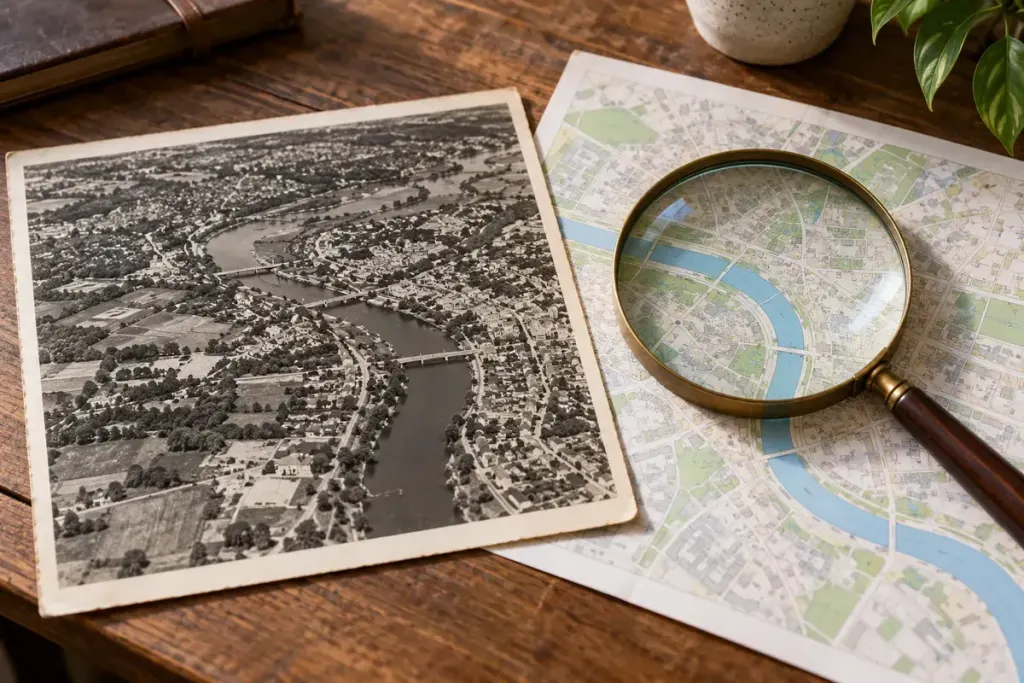
An old aerial photograph shows a building where today’s car park stands. It is tempting to attach the photograph’s date to the building itself. What the image establishes is narrower: the building was visible when that photograph was taken, assuming the date and identification are correct.
Collect the image’s own details
Record the archive reference, capture date if supplied, photographer or survey and any notes about the print or digital copy. A publication date, scanning date or handwritten annotation may refer to a later stage in the image’s life.
Keep an unaltered copy of the catalogue information beside your working notes. If you crop the image for comparison, retain the reference that lets you return to the full frame.
Use fixed features to orient the view
Compare street junctions, railway alignments and other identifiable features before naming individual buildings. Perspective, shadows and later road changes can make a familiar area surprisingly difficult to recognise from above.
Then describe what is visible in cautious terms. “A roofed structure occupies this corner in the dated image” is stronger evidence than “the house was built that year”. Construction records, directories or earlier images may be needed to narrow the timeline.
A useful comparison uses at least two dated observations. If the structure is absent in one and present in another, that can suggest a period to investigate, while still allowing for differences in image quality, coverage and interpretation.
When sharing the finding, distinguish the archive’s description from your inference. Invite corrections with the reference attached, rather than posting an attractive crop whose source has been lost.
The reward is a history others can check. A photograph becomes more than an illustration when its date, viewpoint and limits remain visible alongside the story you tell about the neighbourhood.