
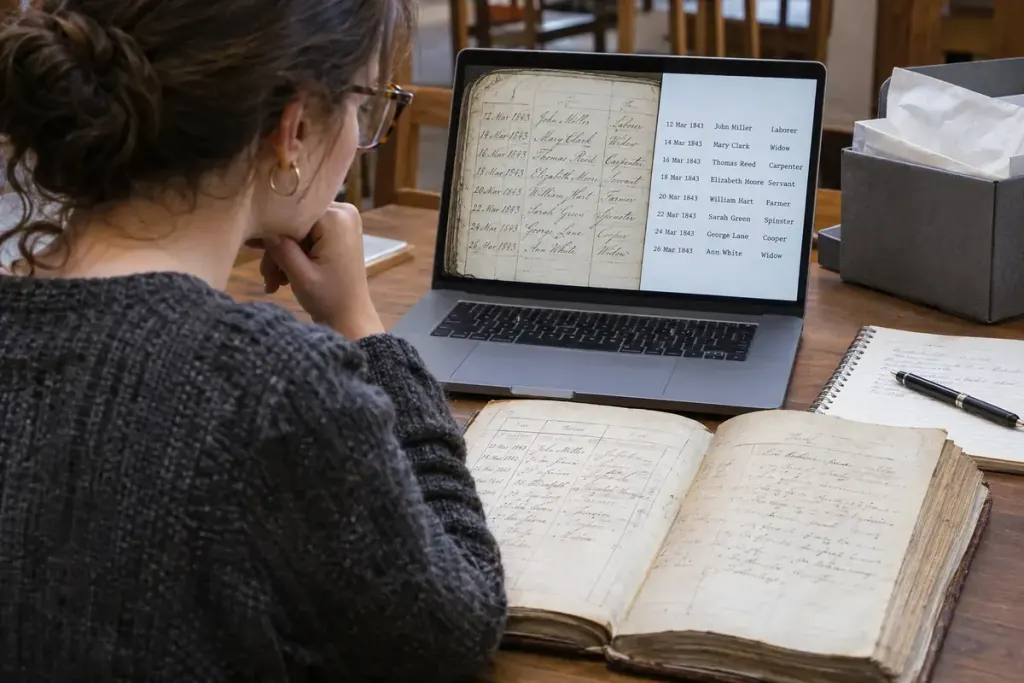
A searchable transcription can find a family name in seconds. The original register may then reveal that the name was corrected, squeezed into a margin or connected to the next row by a bracket. Both versions are useful, but they preserve different parts of the record.
The US National Archives explains in its Citizen Archivist transcription guidance that typed text improves searchability, especially for handwritten documents. It also notes the difficulties posed by ink, markings and mixed handwriting and type. A search result is an entry point into that evidence.
Check the details that carry your claim
If your conclusion depends on a date, occupation or household relationship, inspect that part of the image closely. Compare the writer’s letters elsewhere on the page before deciding that an unfamiliar mark is a particular name. Look at the column headings and adjacent entries as well as the isolated word.
For an illustrative local-history note, a transcription might place an address beside a person’s name while the original uses a ditto mark referring to an earlier row. Copying the text without checking the layout could attach the wrong address to the person.
Preserve uncertainty in your notes
Record the archive reference, page or image identifier and the transcription source separately. Write “reading uncertain” when that is the honest result. A tentative reading does not become certain because it has been copied into several family trees or local-history posts.
The National Archives’ practical transcription instructions also help explain why a searchable text may not reproduce every visual feature. If you discover a likely transcription error, use the archive’s correction process rather than silently altering a quotation and presenting it as the source.
A useful published account distinguishes what the document says from what you infer. The original can contain errors too: a clerk may have misunderstood a name or recorded an inaccurate age. Comparing versions strengthens the research, but it does not remove the need to ask how the record was created and what its author could have known.