
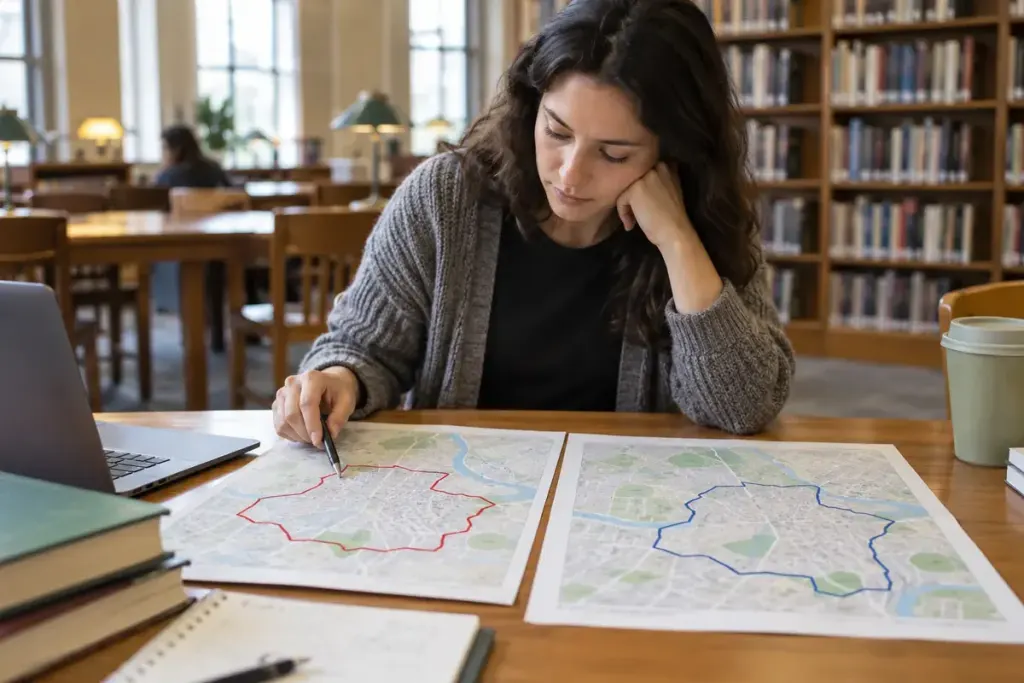
Two charts use the same neighbourhood name, but one includes the new housing estate across the railway and the other does not. Their totals may both be correct while describing different places.
Find the geography behind the label
Look for a boundary map, area code or definition in the dataset’s documentation. Everyday neighbourhood names do not always match statistical, electoral or administrative areas. A familiar label is not enough to establish that two sources use the same footprint.
Save the geography’s version or date. Boundaries can change between releases, and a later area may combine or divide earlier ones. Do not treat a renamed area as identical without checking.
Match the measurement as well as the place
Compare the period, population and unit. Residents, households, registered voters and service users are different groups. A count and a rate answer different questions, even when both appear beside the same place name.
For an invented example, a district’s number of library visits could rise because the boundary now includes another branch. That would not by itself show that each resident visits more often. Read the collection method before offering an explanation.
Make a small comparison record
- Source and publication date.
- Area name, code and boundary version.
- Period and population being measured.
- Whether the source says the figures are comparable.
If the definitions differ, look for an official comparable series or an explanation from the data provider. Avoid inventing a conversion by simply dividing one total by another. Some changes require a documented geographic correspondence or cannot support a clean comparison.
When sharing the result, state the limit in the sentence that contains the comparison. “These figures cover different boundaries” is more useful there than in a distant footnote nobody reads.
Local statistics become more informative when the place is defined precisely. Before asking why the number changed, establish whether the number is still describing the same neighbourhood.