
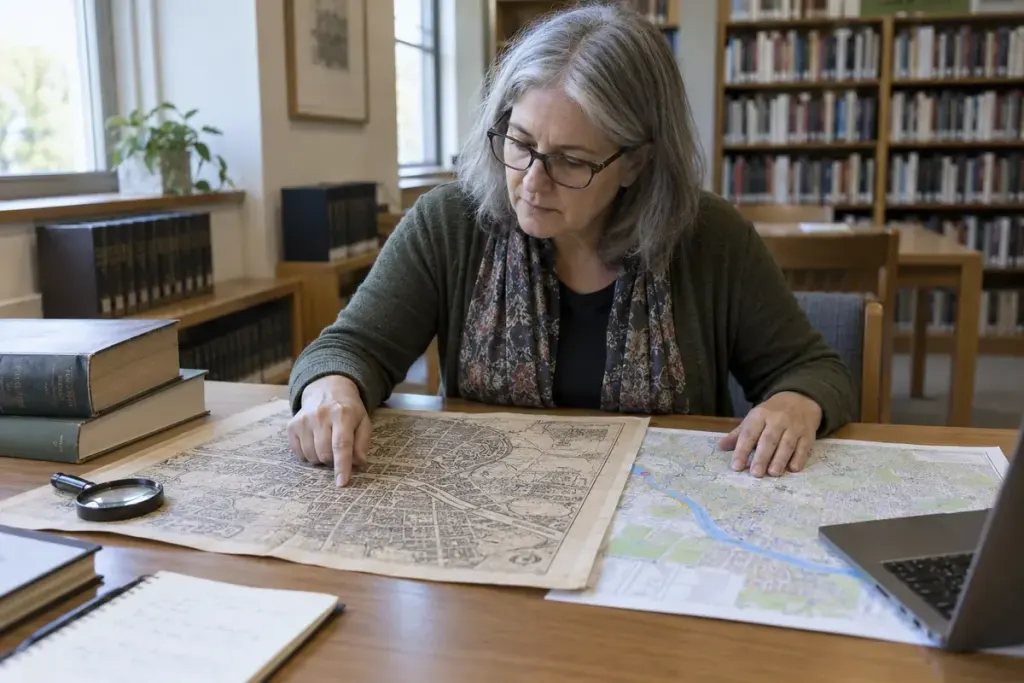
An old address can look as if it refers to a vanished place when the street simply appears under another name today. The opposite problem is just as easy: a familiar name may have referred to a different stretch of road in an earlier period. Start with the date, not the resemblance.
Write down the address exactly as it appears, including spelling, numbering, and the document’s language. Keep a photograph or reference to the original. Modernising the name too early can erase the clue that helps connect it with a contemporary directory.
Read the map’s own dates
A map may carry a survey date, a revision date, and a publication date. These are not always identical. A reprint sold recently may reproduce much older information. Look at the catalogue description and map legend before deciding which moment the street name represents.
Compare several stable features: a junction, a public building, a watercourse, or the shape of a block. One matching name is weaker evidence than a group of features in the same relationship. Remember that buildings and routes can change too.
Keep an address history rather than one replacement
A simple research note can list the source date, recorded street name, recorded number, and your proposed present-day location. Mark uncertain connections as uncertain. If a renumbering occurred, changing the street name alone will not locate the house.
Useful supporting records may include municipal decisions, dated directories, cadastral material, and local archive catalogues. Their availability varies. Ask the archive which records cover the period instead of assuming a current online map preserves every earlier name.
When sharing the result, explain the chain of evidence in a sentence or two. “This address appears to correspond to…” is more honest than a definitive label when numbering remains unresolved. The old name becomes valuable because it is connected to a time and source, not merely translated into something familiar.