
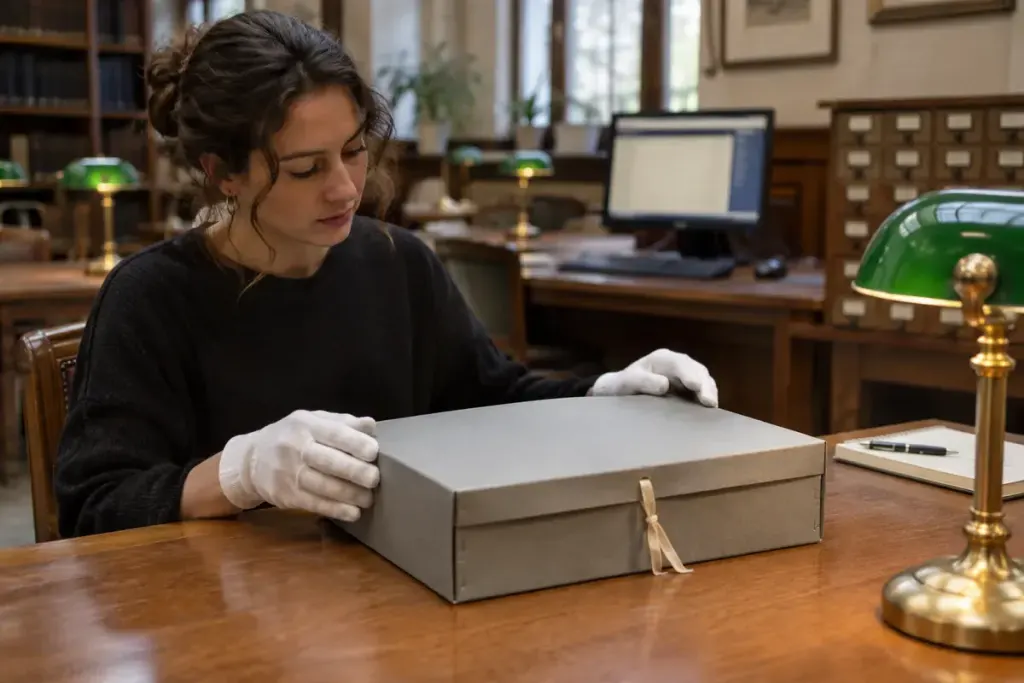
A catalogue search finds a promising file about your town, but its access status says closed. The description can still help orient your research. It may identify a reference number, date range, creating organisation or relationship with other records, even when the contents cannot be consulted.
Keep a firm distinction between the catalogue entry and the document itself. Reading a title does not establish what every page says, and a closure label does not prove that a file has been lost or destroyed.
Save enough information to ask a useful question
Record the archive, full reference, displayed title, date range, access status and the date you checked. Preserve the catalogue URL if one is available. Note whether the description itself is limited, rather than filling the gap with a guess about named individuals.
The UK’s National Archives explains that some closed records can be the subject of a Freedom of Information request through its catalogue. That is an example of one institution’s process, not a universal access right or procedure for archives in other countries.
For a local collection, ask the archive what review or access process applies and whether related open records may help. A reference number lets staff identify the exact item more efficiently than a broad request for “everything about this event”.
Use the surrounding collection responsibly
A series description can explain why the records were created. Nearby open files may provide background, but they cannot stand in for the closed file’s unseen contents. Avoid quoting a neighbouring document as if it proves what the restricted one contains.
In your research notes, use a clear label such as “catalogue description consulted; file not viewed”. If you later receive access, add a new dated entry rather than silently rewriting the earlier evidence trail.
The useful outcome may be a better question, a different source or a documented limit. Historical research remains stronger when readers can see where the evidence stops, even when the catalogue has led you tantalisingly close to the subject.