
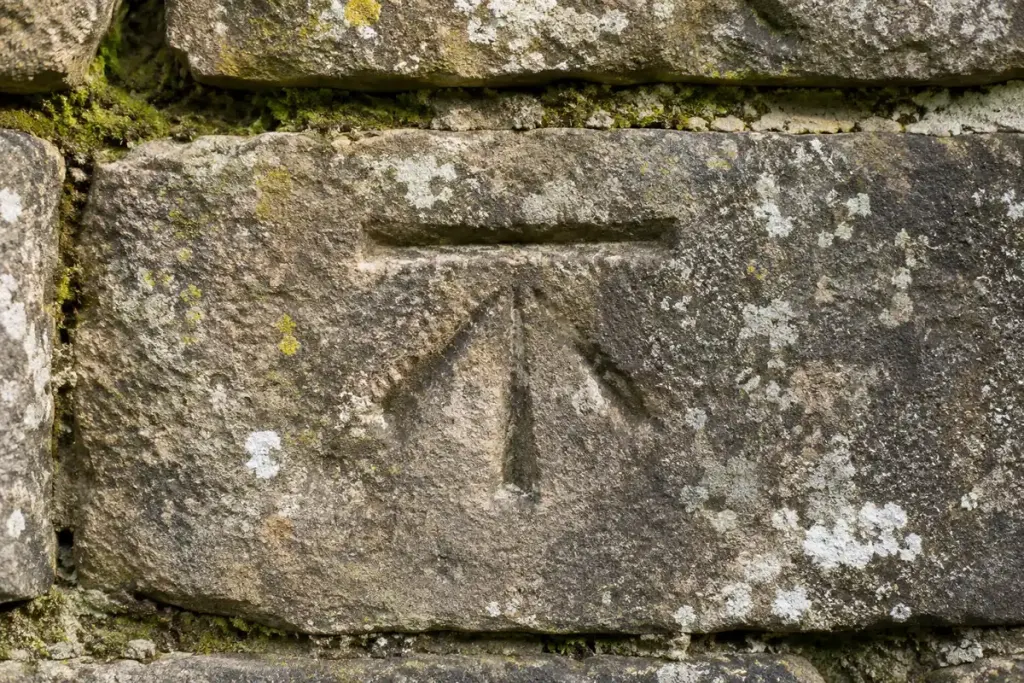
A small cut mark on an old wall can be easy to overlook. Some such marks were made for surveying, providing a reference connected to a measured level. They are not street numbers, decorative arrows or instructions to visitors.
Recognising the possibility is the beginning of an investigation, not a reason to assign a precise height from appearance alone.
A level needs a reference system
Ordnance Survey’s benchmark information explains a British system linked to levelling and height data. It also makes clear that much ordinary benchmark information is legacy data rather than a promise that every old mark remains reliable.
That example helps explain the concept. It should not be applied automatically to a mark found in Subotica or elsewhere: local survey authorities, historical systems and symbols may differ.
Record before interpreting
If you notice a possible benchmark during a walk, photograph it from a public location without touching or altering it. Take a wider view showing the building and a closer view showing the mark. Note the location and date.
Useful questions include whether the structure has been rebuilt, whether a nearby plaque identifies the mark, and whether a local archive or surveying authority holds a record. A mark moved with a stone or affected by building movement may no longer serve its original purpose.
Do not turn a historical clue into a measurement
Imagine an illustrative record listing a height beside a mark on a railway building. Before using that number, a surveyor would need to establish the datum, the mark’s identity and its current reliability. Copying the figure into a renovation plan skips those essential checks.
For local history, uncertainty can be recorded honestly: “possible survey mark; identification not confirmed.” That is more useful than an attractive but unsupported explanation.
The next time you pass an old public building, look at the stonework as well as the name above the door. A small technical mark may preserve evidence of how the town was measured—but its story needs records to match the stone.