
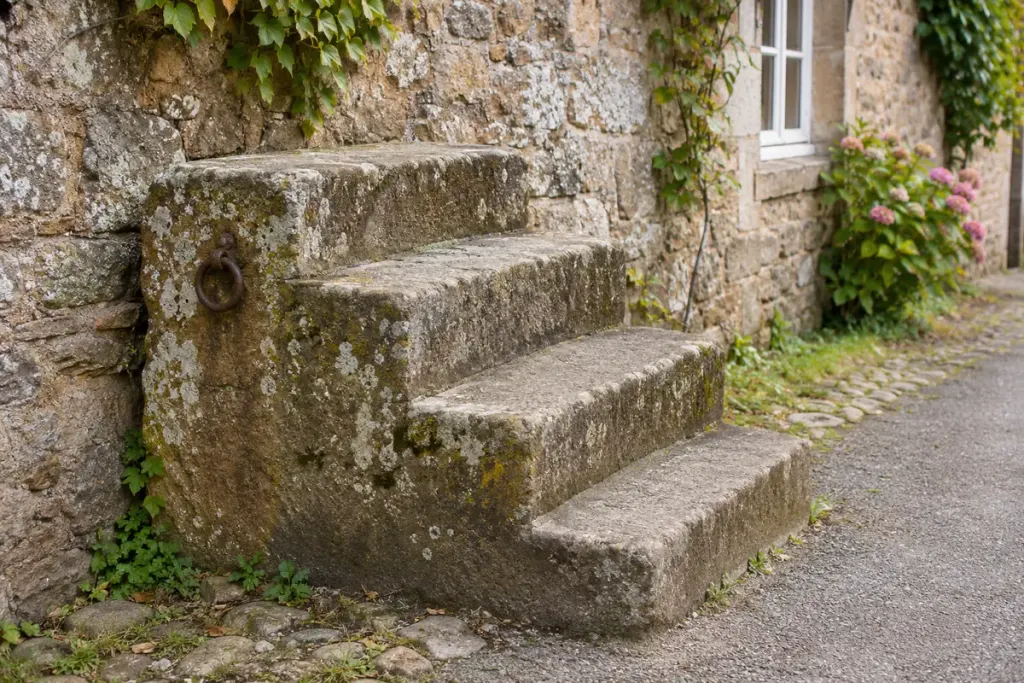
Three stone steps stand against a village wall, apparently leading nowhere. Before assuming that a doorway has disappeared, consider another possibility: a mounting block, used to help a rider get onto a horse.
Historic England records examples as individual heritage features. Its entry for the mounting block at Spofforth describes a probable eighteenth- or early nineteenth-century example. That record establishes the interpretation of a particular object; it does not prove that every isolated set of steps had the same purpose.
Read the relationship with the street
Notice the block’s height, the arrangement of its steps and the space beside its highest platform. A rider would need room for the horse as well as a way to climb. The nearby building and route may provide context, but avoid turning a plausible story into a certainty without supporting evidence.
A relocated block can be especially misleading. Its present position may have been chosen for display or protection, rather than preserving the original working arrangement. Check whether the official description mentions movement, rebuilding or uncertainty about its date.
Make a record that another person can follow
Photograph the whole feature and its surroundings from the public route. Record the location and the date of your observation. If there is an interpretation panel, note who supplied it. Then compare the description with a local heritage register, historic map or archive photograph.
Keep separate notes for what you can see and what the documents say. “Three worn stone steps beside the wall” is an observation. “Used by worshippers arriving on horseback” would need evidence connecting that function to the site.
Small street objects can reveal ordinary movements that grand buildings overlook. The point is not to invent a picturesque anecdote for every stone. It is to recognise a possible function, look for a reliable record and leave uncertainty visible when the surviving evidence does not settle the story.