
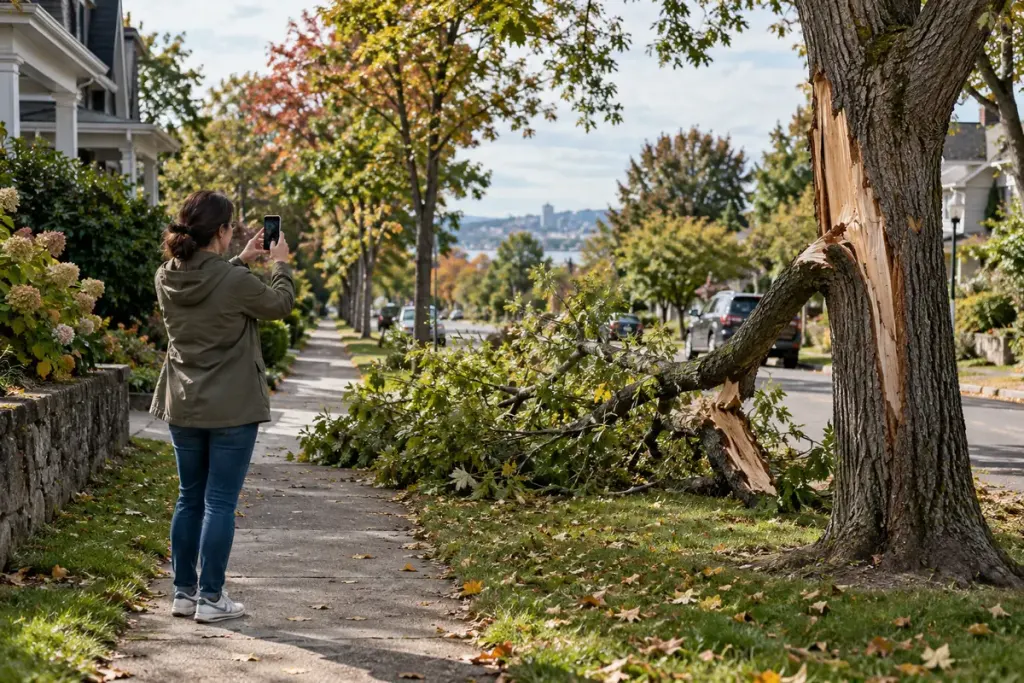
A branch is damaged above the pavement, but the tree stands close to a private garden. Should the report go to the council, the road authority or the property owner? Guessing can send a useful warning into the wrong inbox.
Start with the location and the nature of the concern. The organisation responsible for a tree depends on ownership and local arrangements; being beside a public path does not by itself establish who maintains it.
Describe what you can safely observe
From a safe distance, record the street, nearest address or landmark and which side of the road the tree occupies. A map pin can help where several trees look similar. Take a wide photograph for location and another showing the concern only if doing so is safe.
Write “large branch visibly split over pavement” rather than diagnosing a disease from a photograph. Do not stand underneath unstable limbs, touch fallen electrical lines or attempt to remove a branch yourself.
Choose the reporting route by urgency
Use the local authority’s official tree or highway reporting service for routine concerns. If there is an immediate threat to people, traffic or utilities, follow the relevant local emergency procedure and keep clear. A web form intended for ordinary maintenance may not be monitored continuously.
Plant health can involve a different route. The UK government’s tree pest and disease reporting guidance explains its national arrangements, including certain reportable concerns. It is an example of why a disease report and an urgent fallen-branch report should not be treated as interchangeable.
Keep the reference, then follow up precisely
Save the report number, date and the organisation contacted. If the service says the tree belongs elsewhere, ask which authority or owner is appropriate and retain that answer. Repeatedly submitting the same vague message to several departments can make the history harder to follow.
A helpful follow-up identifies a changed condition: “Since report 123, the branch has moved lower over the path.” It should not imply that a professional assessment has happened unless you have confirmation.
Street trees provide shade and character, and maintenance decisions can involve health, access and safety. A clear resident report contributes useful evidence without requiring you to become an arborist. The best first contribution is an accurate location, a factual description and the right route for the urgency involved.