
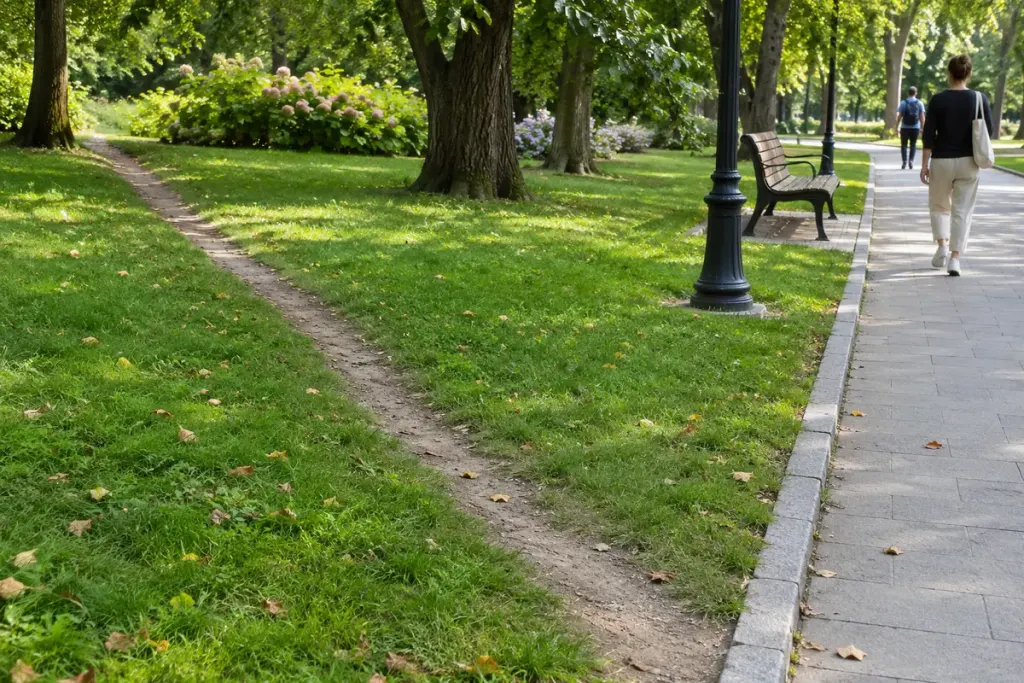
A paved path turns neatly around a lawn, while a narrow strip of bare ground cuts straight across it. The second route may be a desire line: a trace of repeated movement showing where people find it convenient to walk.
Belfast City Council’s placemaking guidance describes established desire lines as worn routes that can reveal shorter or more convenient connections. They are useful evidence for design because they show a relationship between the planned layout and everyday behaviour.
Notice the journey at each end
Rather than photographing the worn grass alone, look at what the route connects. Is there a bus stop, entrance, crossing or bench? Does the paved route require a long detour? Is the shortcut avoiding an obstruction?
Observe at more than one time if you can do so respectfully from public space. A school-hour pattern may differ from a weekend one. Avoid collecting identifiable photographs of passers-by when a simple count or sketch answers the question.
A line on the ground leaves questions open
The visible route does not, by itself, establish ownership, formal access rights or the suitability of the surface for everyone. Someone using a wheelchair or pushing a pram may have no practical choice but to take the longer paved route.
East Lothian’s walking and wheeling guidance connects desire lines with a comprehensive, accessible path network. That is a useful design question: can a convenient connection also be made usable for people with different mobility needs?
Turn an observation into a clear request
If you raise the issue with a site manager or council, describe the endpoints, the existing detour and the conditions you observed. Include a simple annotated map if permitted. “People repeatedly walk between these two entrances” is more informative than “the path is badly designed.”
Ask whether drainage, planting, utilities or access arrangements affect possible changes. A worn route is evidence worth considering, not a complete construction plan.
Desire lines make everyday choices visible. Reading them carefully can help a neighbourhood conversation move from a vague complaint toward a specific question about how the place works.