
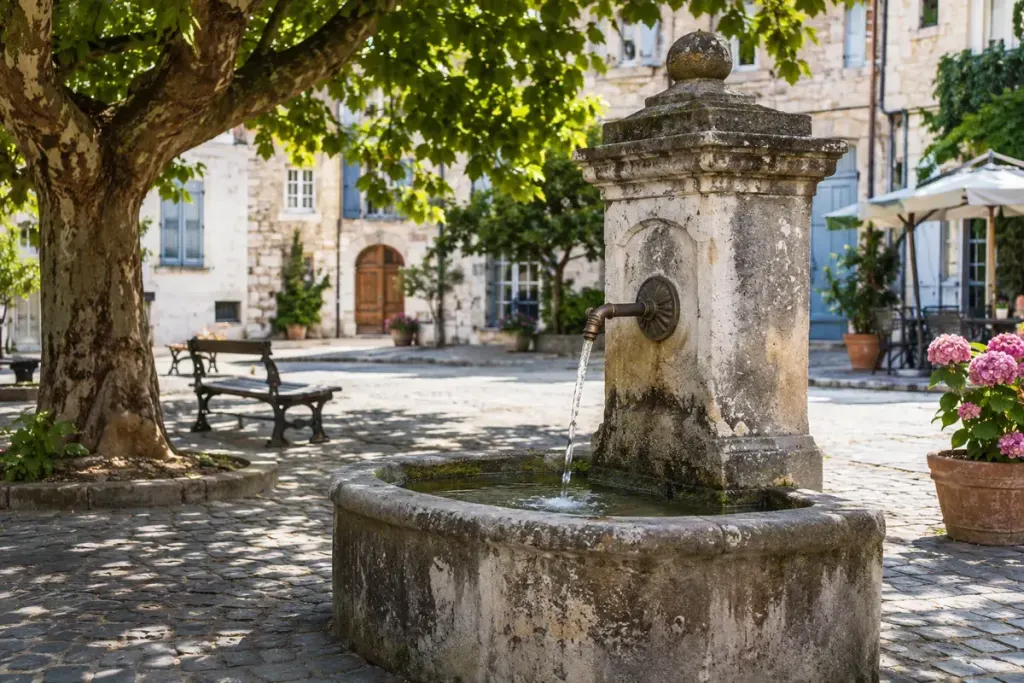
An old drinking fountain can seem like a small decoration beside a busy pavement. Look more closely and it may preserve evidence of public health, philanthropy, commemoration and the daily movement of people through a town.
Historic England’s guide to street furniture places drinking fountains within the history of public utilities. Their value is not limited to an elaborate carving. Location, fittings and the relationship with the street can help explain what a structure was intended to do.
Read the object in layers
Begin with the inscription. Copy the wording and date accurately, keeping uncertain letters marked as uncertain. A date might commemorate a person or event rather than identify the exact installation year. Do not quietly turn one kind of date into another.
Next, look at the arrangement. Is there a basin, a spout, a lower trough, or evidence that fittings have been removed? Are several users or levels of access suggested by the design? Record what survives before deciding how it worked.
Finally, step back. A fountain near a market, park entrance or transport route may have served a different pattern of use from one inside a private courtyard. Present-day traffic can obscure an earlier street layout, so an old map or photograph may be needed to understand its original position.
Follow one question into the records
Choose a question narrow enough to investigate: who paid for the fountain, when it was installed, or whether it was moved. Local newspapers, council minutes, heritage records and dated photographs can provide different pieces of the answer. Keep the source and date beside each note.
Suppose a plaque names a donor while a later photograph shows a changed basin. Those observations can coexist. The donor’s inscription does not prove that every visible part is original, and a replacement basin does not erase the fountain’s earlier history.
Avoid cleaning inscriptions, rubbing surfaces or removing deposits to improve a photograph. The material may be fragile or protected. Use ordinary viewing and ask the responsible organisation about any interpretation already available.
Historical purpose also does not establish current drinking-water safety. A surviving spout or flowing water is not an assurance of potability. Follow present signage and the operator’s guidance.
One small fountain can open a surprisingly large civic story, provided the observation stays separate from the assumptions it invites.