
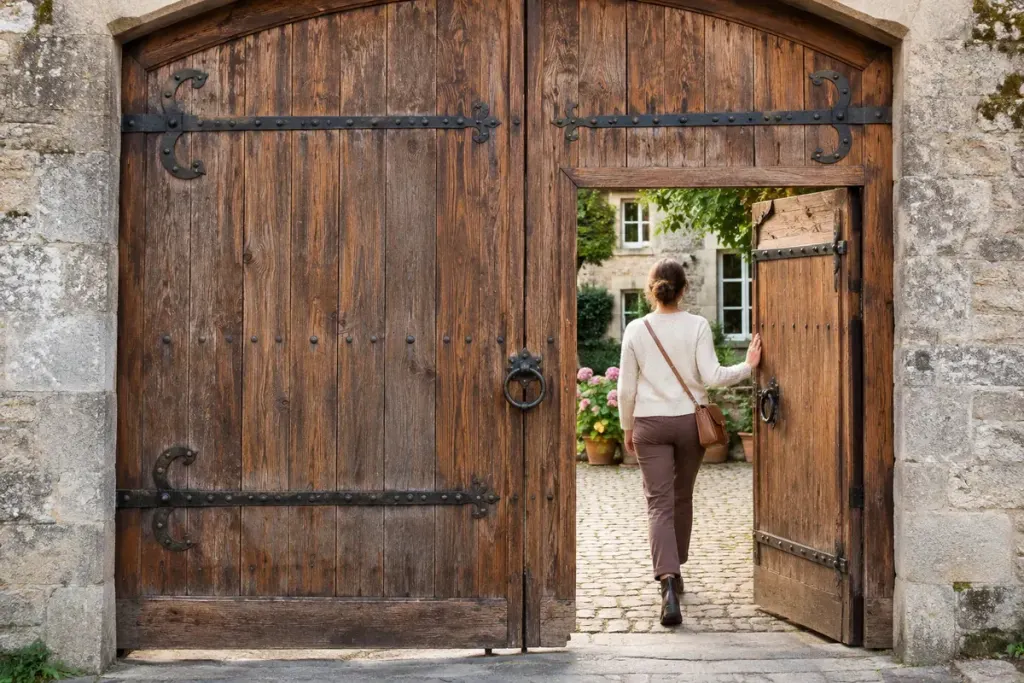
A large courtyard gate may contain a much smaller door within one of its leaves. That inset opening is often called a wicket door. It allows a person to pass without swinging the whole gate, a modest detail that can reveal how an entrance was used in everyday life.
The word also appears in other settings, so read the surrounding description. Historic England’s archive, for example, records a worker passing through a wicket door in a pottery kiln. A wicket in a building record is not automatically a garden gate or a courtyard entrance.
Read the smaller opening as its own doorway
Look for a separate hinge line, latch and frame inside the larger leaf. Notice whether the small door reaches the ground or leaves a raised threshold to step over. The second arrangement can be less obvious in a photograph than it is to someone actually using the entrance.
At a public historic site, observe from the permitted route. A door that looks usable may be secured, fragile or outside the visitor entrance. Do not open it merely to improve a picture.
Ask what has changed
A small door may be original, inserted later or altered during restoration. Differences in timber, fastenings or paint can suggest questions, but they do not establish a date by themselves. Compare your observations with the site’s conservation record or an identified historical photograph.
For a local-history notebook, separate the visible facts from a proposed explanation. “A raised timber threshold remains beneath the small opening” is an observation. “It was designed to exclude a particular person or animal” needs supporting evidence.
Finally, consider present-day access. A narrow inset door may not provide a usable route for everyone, even when it is convenient for some pedestrians. If you are describing a venue, record the actual public entrance and any step-free alternative rather than presenting the historic wicket as the only way in. One small doorway can connect construction, daily use and the changes a place needs today.