
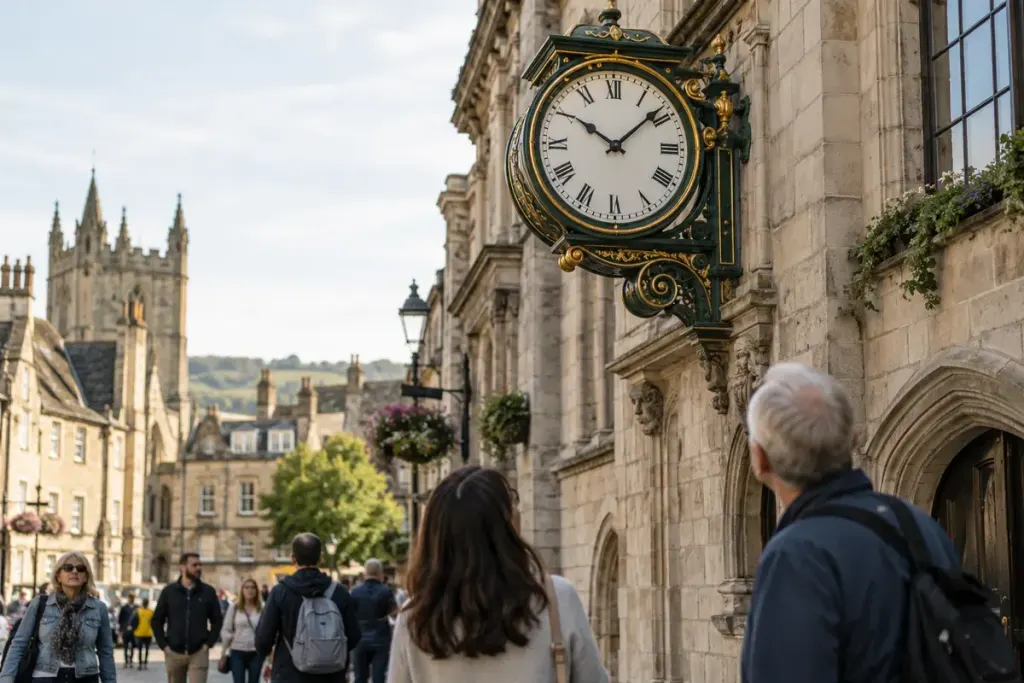
A date on a restored public clock often catches the eye before the clock itself. It can be tempting to use that date as the object’s birthday. Yet the plaque may commemorate a repair, the return of the hands, a new drive mechanism or the reopening of the surrounding building.
Begin with the exact wording. “Restored,” “installed,” “dedicated” and “reconstructed” describe different events. Copy the inscription accurately, including who commissioned the work, rather than converting it immediately into a simpler claim.
Separate the face, mechanism and setting
A clock face can remain in place while the machinery behind it changes. Equally, an older mechanism may have been moved into a later building. Ask which part a document is describing before combining dates into a single timeline.
A useful research sheet has separate entries for the earliest confirmed appearance, known repairs, changes to timekeeping equipment and alterations to the tower or facade. Leave a field marked “not established” when the available record does not answer it.
For an illustrative example, a photograph might confirm a clock on a building in 1910 while a plaque records restoration in 1998. That supports presence by 1910 and work in 1998; it does not, by itself, prove the original installation year or identify the surviving mechanism.
Look beyond a single caption
Compare municipal records, museum collections, local newspapers and dated postcards where available. A postcard’s mailing date is evidence that the image existed by then, not necessarily the date the photograph was taken. Note the catalogue reference so another reader can check your interpretation.
When sharing the story, identify uncertainty openly. “The face appears in this dated photograph” is often more useful than a confident but unsupported age. Record current details from public space without entering restricted machinery rooms.
A restoration plaque remains valuable evidence. It becomes more interesting when treated as one event in an object’s working life, alongside maintenance, adaptation and the people who kept the town’s time visible.