
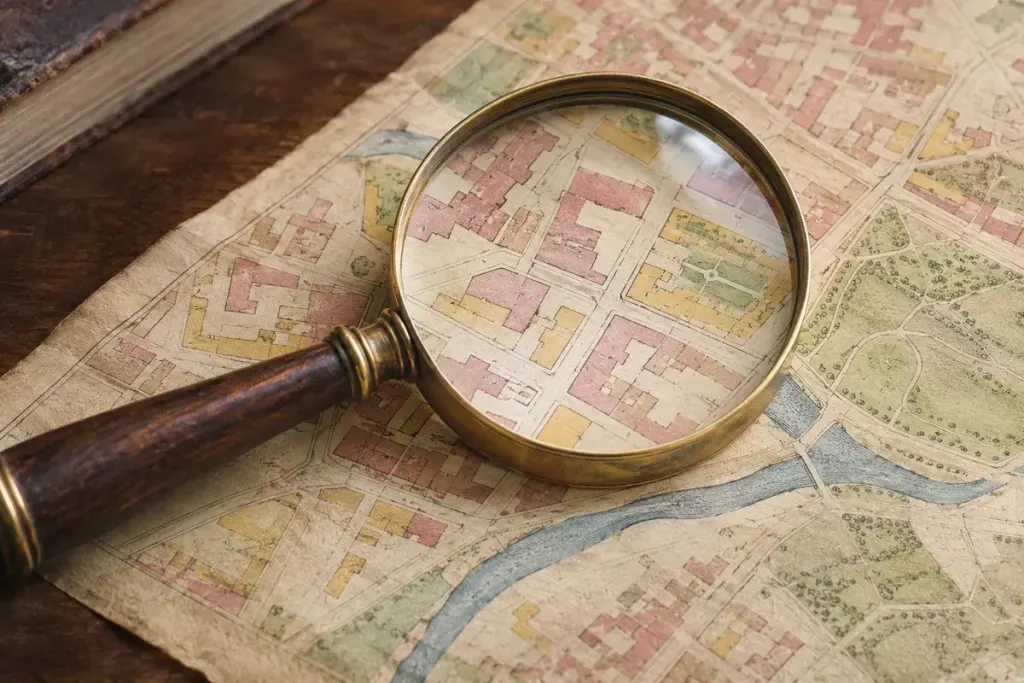
A historic map colours one building yellow and its neighbour pink. Those colours may be evidence about construction rather than decoration. Fire-insurance maps were made to assess specific risks, so they often recorded details that ordinary street maps omitted.
The Library of Congress introduction to Sanborn maps explains their specialised purpose and the importance of keys, symbols and colours. In familiar Sanborn conventions, yellow commonly represents wood-frame construction and pink indicates brick. The key and notes for the actual sheet remain essential, especially for mixed materials and revised editions.
Begin with the sheet, not the colour
Record the map title, place, sheet number, scale, publication date and any revision information. Locate the building through more than its modern street number. Streets can be renamed and numbering systems can change.
Then read the whole footprint. Small extensions, dividing lines, storey annotations and stated uses may tell a more complicated story than the dominant colour. A building could contain different construction types or have an addition that changes how the plan should be interpreted.
Make a comparison that admits uncertainty
Suppose an early sheet shows a small structure and a later sheet shows a larger footprint. That is evidence of a mapped change between the records, not automatically the exact date of construction. Look for permits, directories, photographs or other local records to narrow the explanation.
A useful research note separates “the map shows” from “this may suggest.” Keep the reference with the observation so someone else can return to the same sheet.
Sanborn is a particularly rich example from the United States. It should not be assumed to provide coverage for every European town. For research in Subotica or another locality, ask the relevant archive what cadastral, building or insurance records survive and how their own symbols work.
The transferable skill is learning why a map was made. Once its purpose, date and conventions are clear, a coloured rectangle can become a starting point for a better question about the street’s history.