
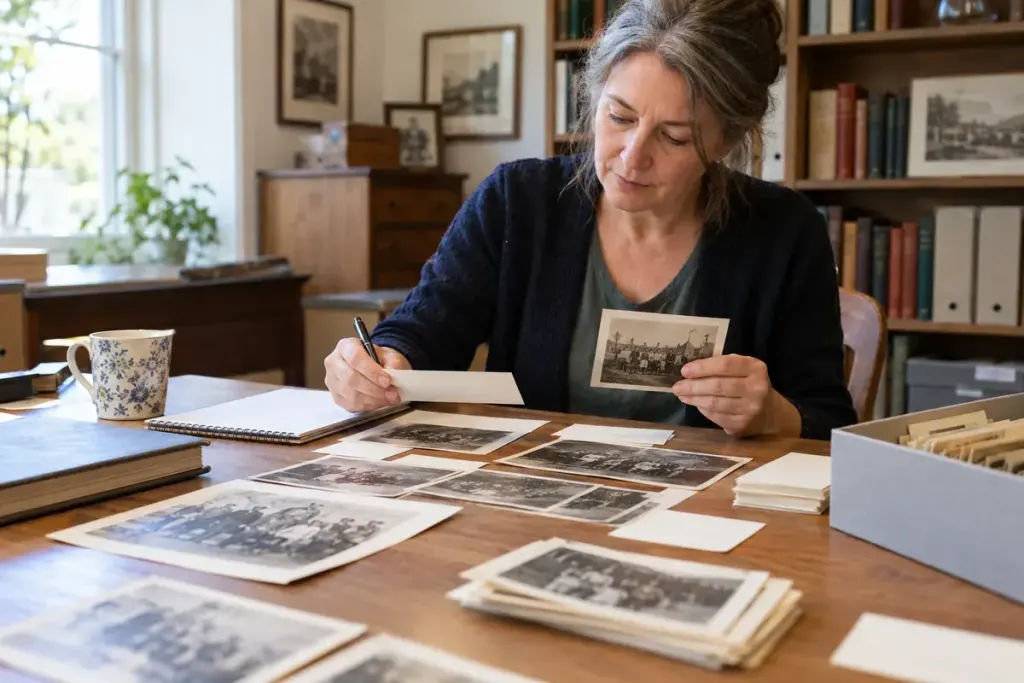
A donated photograph arrives with “Mrs Novak, 1978” written on the envelope. Is she the photographer, the person pictured, the owner, or the person who supplied the date? A useful archive record does not force one ambiguous note to answer every question.
Keep the original wording and the envelope with the photograph where appropriate. Make a separate transcription so later readers can distinguish what was supplied from what you subsequently established.
Give each role its own field
Record the photographer or creator, people depicted, date, location, donor and source of identification separately. Use “unknown” when the evidence does not settle a field. A blank can otherwise look like an accidental omission that someone feels obliged to repair with a guess.
For an invented example, a donor may identify their aunt in a market scene but have no idea who took the picture. Credit the donor for that identification without turning them into the photographer. If the date is approximate, preserve the range or uncertainty.
Ask how an identification was made. Personal recognition, a written caption and comparison with another photograph are different kinds of evidence. A brief note about the method makes later corrections easier to understand.
Separate credit from permission
Naming a creator does not establish that you have permission to publish the image. Check the applicable rights and the archive’s policies with a qualified person when needed. Consider privacy and sensitivity as well as the technical ability to upload a scan.
When a caption is corrected, retain the earlier record and explain the change in the archive’s normal process. Do not quietly replace an uncertain identification with a confident one.
A careful caption can remain short for public display while the underlying record holds the detail. That combination lets visitors enjoy the photograph and gives future researchers a fair account of how its story became known.