
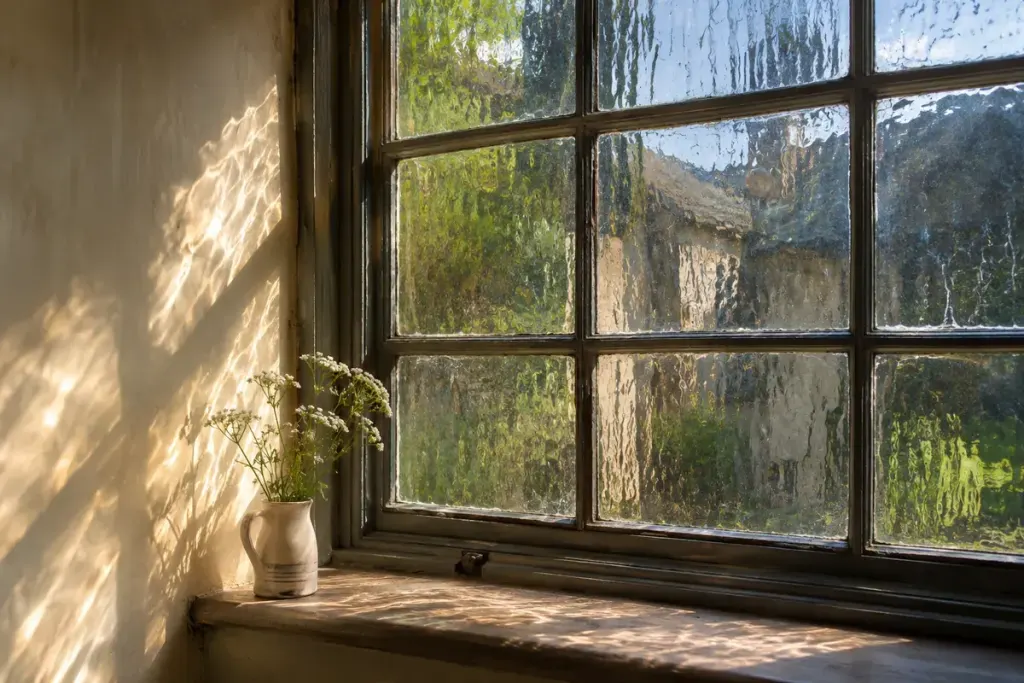
Look through an old window while moving your head gently from side to side. A straight roofline outside may seem to bend or ripple. That small distortion can be part of the pane’s manufacturing history, rather than dirt that needs polishing away.
Historic England’s guide to traditional windows discusses historic glass alongside frames, repair and upgrading. Older production methods can leave variations in thickness and surface character that differ from the uniform appearance of modern float glass.
A clue is not a date stamp
A wavy pane does not prove the age of the whole window or building. Glass can be replaced, reused or deliberately selected for its traditional appearance. The surrounding frame, fixings, records and other panes provide context.
Consider an illustrative street with several nineteenth-century façades. One building may retain early panes in a repaired frame; another may have later glass inside an older frame. A third may contain reproduction glass. Similar reflections from the pavement do not establish identical histories.
Record the detail without disturbing it
For a personal observation notebook, note the address or public building name, the viewing position, light conditions and which pane shows the effect. Photograph only where permitted and respect occupants’ privacy. A second photograph from a slightly different angle can help separate a reflection from a distortion seen through the glass.
Avoid assigning a manufacturing method solely from a phone image. Words such as “uneven reflection” or “small visible bubbles” are useful observations; “original eighteenth-century crown glass” is a conclusion that needs stronger evidence.
If you own an older property, seek appropriate conservation advice before replacing a pane simply because it is imperfect. The Historic England windows overview is a starting point for understanding repair considerations in its jurisdiction; local heritage requirements may differ elsewhere.
Looking closely at glass changes a familiar street scene. Windows stop being interchangeable openings and become records of manufacture, maintenance and alteration—provided we leave room for what a visual clue cannot tell us.