
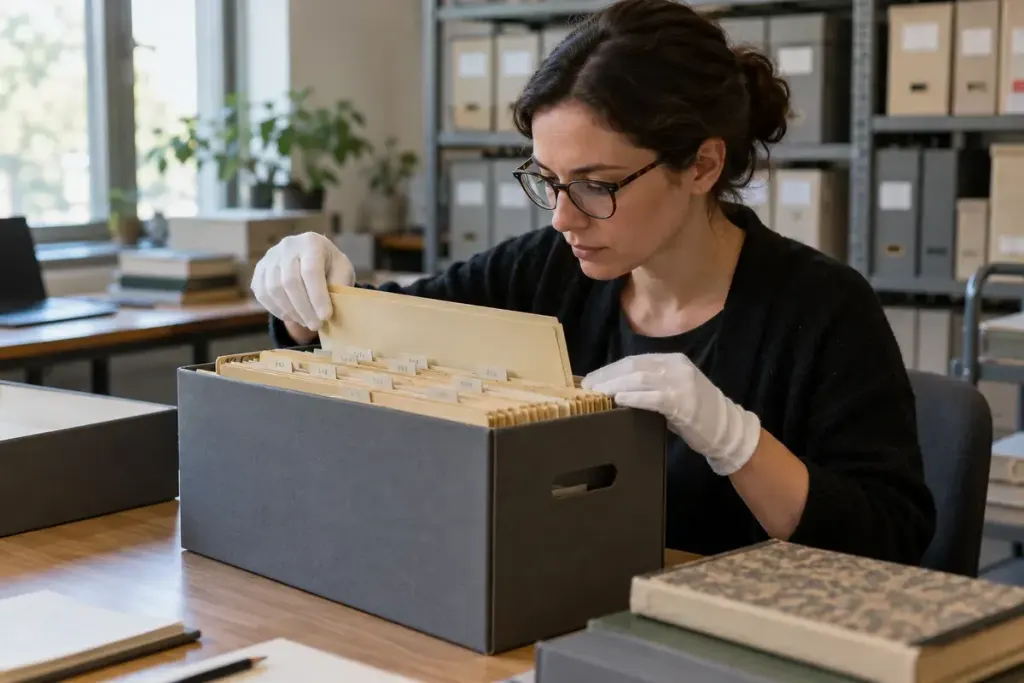
A folder of local committee papers can feel untidy to a modern reader. Letters may appear beside draft minutes, with several dates mixed together. Before deciding that the archive needs sorting, consider whether the arrangement records how the committee actually worked.
The Society of American Archivists defines original order in relation to the organisation and sequence established by the records’ creator. Preserving that arrangement can retain relationships that disappear when every sheet is reorganised by date or subject.
An invented folder example
Imagine a community hall committee keeping one folder for a roof repair. Inside are an early quotation, a letter asking for a revision, the revised quotation and minutes approving the expense. Sorting all the collection’s quotations into one pile and all its minutes into another could make this particular decision harder to reconstruct.
The folder’s sequence is evidence about a working process, but it is not proof that every document was filed perfectly. People misfile papers; records arrive incomplete; archivists sometimes need to reconstruct or impose an arrangement. Read the collection description and ask staff what is known.
During a visit, preserve the order you are given. Follow the repository’s handling instructions, keep folders distinct and avoid inserting your own labels or moving documents to make a photograph look clearer. If something seems out of place, report it rather than correcting it yourself.
Your notes can use a different intellectual order without changing the originals. Create a timeline in your notebook, but keep each entry tied to its collection and folder reference. Record your interpretation separately from wording actually present on the document.
When a digital search hides the folder
A search result may open one scanned page without showing its neighbours. Look for the parent file, series description or finding aid before treating the page as a self-contained story. Ask whether adjacent material has also been digitised.
Original order is a reason to study relationships, not a rule that an archive must always look neat. The apparent clutter may contain the route by which a local decision was proposed, challenged and finally recorded.