
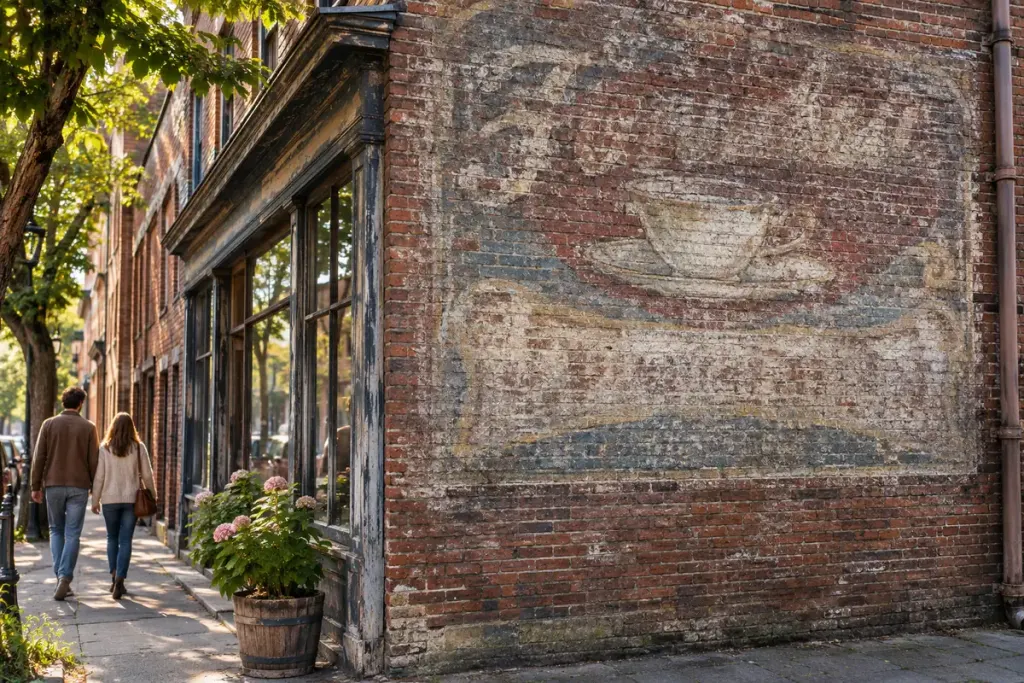
Above a modern shopfront, a few faded letters may belong to a business that disappeared decades ago. These painted advertisements are often called ghost signs. They can survive because a wall was sheltered, covered by another building, or simply left alone.
Historic England’s ghost signs feature shows how this kind of everyday commercial lettering becomes part of a place’s heritage. A sign is a valuable clue, but a fragment of paint is rarely enough to reconstruct a business’s whole history.
Start with a careful transcription
Photograph the wall from a public place without entering private property or obstructing a footpath. Take one view that includes the building and another showing the lettering. Record the date, street, wall orientation, and the words you can confidently make out.
Keep uncertain letters visible in your notes. “B—KER” is more honest than turning an indistinct fragment into a particular family surname. Overlapping paint may also belong to different advertisements; do not force every surviving word into one sentence.
Next, compare the evidence with local directories, dated photographs, maps, or archive records. A directory can connect a trader with an address in a particular year, while a photograph may narrow down when a sign was visible. Neither automatically proves when the paint was first applied.
Let the gaps remain gaps
Suppose a wall says “repairs” but the present business sells clothing. The word alone cannot tell you whether the former occupier repaired shoes, bicycles, or machinery. Write down the competing possibilities and the source that would help distinguish them.
A small street-history record becomes stronger when it separates observation from interpretation. Use a caption such as “faded advertisement, date not yet established” until the evidence supports something more precise. The appeal of a ghost sign lies partly in its survival; there is no need to supply an invented story to make it interesting.